

[ad_1]
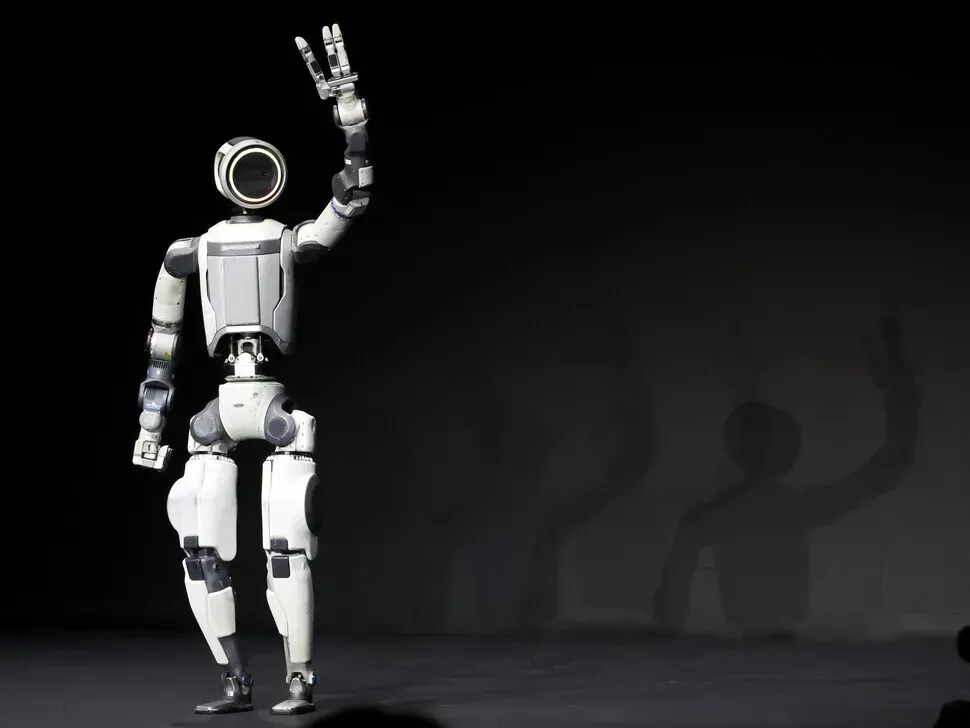
Hyundai Motor Group unveiled its new humanoid robotic, “Atlas,” on Jan. 5, 2026, forward of CES 2026 in Las Vegas, Nevada. (Yonhap)
Hyundai Motor Group’s announcement of plans to deploy its new humanoid robotic “Atlas” in manufacturing amenities has been met with fierce backlash from the corporate’s labor union. Trade observers observe that South Korea is No. 1 on the earth by way of robotic adoption in factories, indicating vital potential for the extra widespread utilization of robots — and accompanying controversy.
“We won’t tolerate any orders that haven’t been agreed upon by each the labor union and administration,” the Hyundai Motor department of the Korean Metallic Staff’ Union said in its e-newsletter on Thursday, addressing the switch of manufacturing quantity to Hyundai Motor Group Metaplant America (HMGMA) in Georgia and the introduction of recent robotic automation expertise.
“We won’t permit any robots to enter manufacturing websites with out our permission,” the union said, signaling a direct confrontation with the corporate, which is pursuing value discount and manufacturing effectivity.
The labor union’s sturdy mistrust of automation is symbolized by Atlas, a humanoid robotic mannequin. Boston Dynamics, a US robotics firm acquired by Hyundai Motor, unveiled Atlas at CES 2026 earlier this month. Hyundai Motor introduced its plan to deploy Atlas at HMGMA beginning in 2028 and its purpose to ascertain a system able to mass-producing 30,000 robots yearly in order to deploy them throughout varied meeting processes.
Boston Dynamics says Atlas can study most duties inside a day and autonomously deal with various high-intensity labor, together with lifting objects weighing as much as 50 kilograms over 2 meters.
The problem is that the deployment of humanoid robots like Atlas will probably spark employment insecurity and exacerbate inequality within the workforce.
An October 2025 survey of 1,000 working Koreans nationwide aged 19 and over carried out by Gabjil 119, an activist group that battles office abuse, reveals that one in two employees (48.2% of respondents) in Korea had been afraid that they might get replaced by AI.
Eight out of 10 respondents (77.9%) estimated that the unfold of AI would make labor market inequality and wealth polarization even worse, pointing to rising issues that bodily AI may quickly start to interchange human labor.
Whereas Atlas has sparked renewed debate on the problem, South Korea is already the world’s No. 1 adopter of business robots.
In keeping with 2024 information from the Worldwide Federation of Robotics, South Korea had the best robotic density — the variety of robots per 10,000 staff — on the earth, at 1,012. South Korea was adopted by Singapore (770), China (470), Germany (429) and Japan (419), with the worldwide common being 162.

Hyundai Motor Group’s new humanoid robotic, “Atlas.” (courtesy of Hyundai Motor Group)
The deployment of robots has been on the rise not solely within the automotive business, but additionally in sectors identified for high-intensity and high-risk operations, akin to shipbuilding and metal manufacturing websites. Hanwha Ocean, which has confirmed the potential of automating collaboration between human welders and robots in indoor manufacturing processes, plans to progressively double the automation charge at its shipyards, aiming for 100% automation in welding by 2030.
Posco Group has additionally been deploying Boston Dynamics’ quadruped Spot robots since 2023, utilizing them for upkeep in areas which might be troublesome for people to entry, akin to areas round blast furnaces.
“If we maximize our present technological capabilities, will probably be doable to interchange human employees with robots for harmful processes that include excessive fatality charges,” a shipbuilding business official instructed the Hankyoreh on Sunday.
“Nonetheless, backlash from labor unions is prompting companies to tread with warning whereas carefully monitoring the discourse surrounding Hyundai Motor Group and its utilization of Atlas,” they added.
“As a monumental change that can change the paradigm of companies, the deployment of humanoid robots akin to Atlas in factories will trigger tensions to run excessive between firms and labor unions. However that is additionally a chance to set the instance for an exemplary negotiation,” commented Lee Byoung-hoon, a professor emeritus of sociology at Chung-Ang College and professional on labor relations.
“The corporate and the labor union should talk and negotiate with each other to search out the very best final result that would be the least detrimental to jobs and labor circumstances,” he emphasised.
An official with the Korean Metallic Staff’ Union mentioned, “The collective bargaining settlement exists to make sure that the labor union is consulted when and if adjustments happen in employment and work environments. The Hyundai Motor native of the union desires the administration and employees to achieve an settlement on the introduction of Atlas.”
By Lee Jae-ho, employees reporter; Yoo Ha-young, employees reporter; Park Da-hae, employees reporter
Please direct questions or feedback to [english@hani.co.kr]
[ad_2]
