

[ad_1]
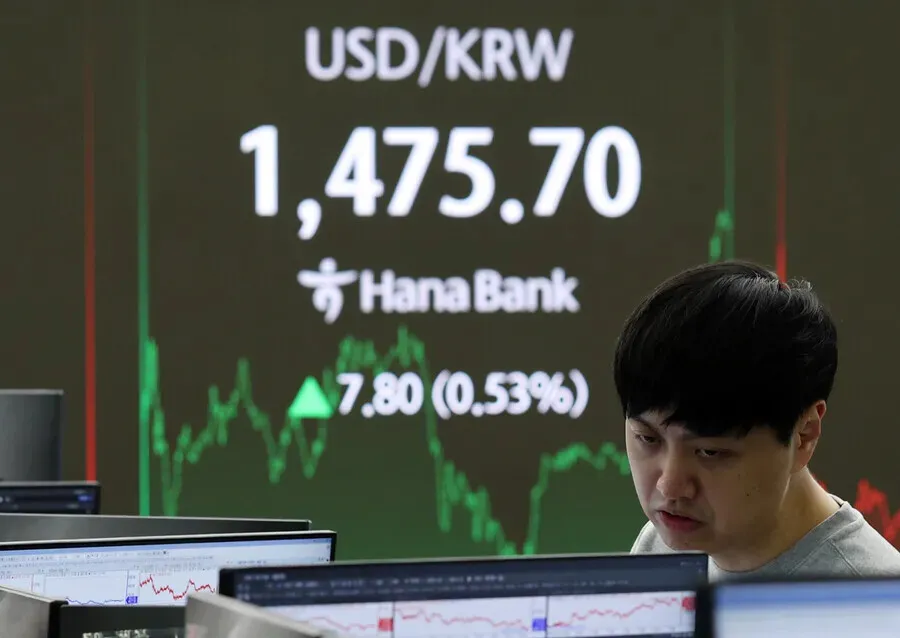
A monitor on the Hana Financial institution buying and selling room exhibits the dollar-won change fee on Nov. 21, 2025. (Yonhap)
The worth of the gained is plummeting ad infinitum. The won-dollar change fee closed at 1,475.6 gained on Friday, up 7.7 gained from the day prior to this as overseas traders internet bought over 3.2 trillion gained price of shares on Seoul’s inventory market. This marked the very best the change fee has been in seven months, nearing the 1,495.5 gained change fee recorded on April 9.
The gained’s actual worth, calculated relative to the currencies of all South Korea’s buying and selling companions, has already fallen to ranges final seen through the 2009 world monetary disaster triggered by the US.
The Financial institution for Worldwide Settlements’ actual efficient change fee, or REER, for the gained as of Sunday stood at 89.09 (2020 = 100) as of the tip of October, solely barely larger than the degrees on the finish of August 2009 (88.88).
The gained’s nominal efficient change fee, which was at 88.63 on the finish of October, dipped to 86.55 on Nov. 18, suggesting that the REER has probably declined additional in November.
REER signifies the true buying energy of a forex relative to the currencies of its main buying and selling companions by reflecting value actions and commerce shares.
On the finish of October, China’s yuan stood at 87.9, and Japan’s yen at 70.4. Amongst main economies since 2020, the Korean gained has seen the second-largest decline in actual worth after these two currencies.
The sharp depreciation of the currencies of the three East Asian nations which have giant manufacturing sectors and have loved excessive progress displays the truth that the financial fundamentals of the three nations have weakened considerably. Particularly, Korea and Japan are dithering when it comes to financial progress, trailing behind the US, which is resulting in capital flight to the US.
The Financial institution of Korea’s preliminary report on the steadiness of funds throughout September 2025 exhibits that home traders’ abroad securities investments elevated by US$99.85 billion from January to the tip of September this yr, whereas overseas traders’ investments in Korea rose solely by US$39.46 billion.
Korea’s rates of interest, low relative to these within the US, are additionally an element within the gained’s depreciation. Latest expectations that the US Federal Reserve’s Federal Open Market Committee wouldn’t minimize its rates of interest in December precipitated the greenback index, which had fallen to round 96, to rise to 100, inflicting the won-dollar change to spike.
The additional depreciation of the yen, pushed by Japan’s Prime Minister Sanae Takaichi’s pursuit of expanded fiscal spending, additionally drove the won-dollar change fee to crash. The yen-dollar change fee leapt from 147.45 yen on Oct. 3, the day earlier than Takaichi was elected as Japanese prime minister, to 157.48 yen on Nov. 20.
Market analysts see an growing chance of presidency intervention if the gained continues to fall.
“With a 1,500 gained change fee nicely inside the realm of chance, there’s basically nothing left that may cease the precipitous depreciation of the gained aside from monetary authorities,” assessed Min Gyeong-won, an analyst at Woori Financial institution.
By Jeong Nam-ku, employees reporter
Please direct questions or feedback to [english@hani.co.kr]
[ad_2]
