

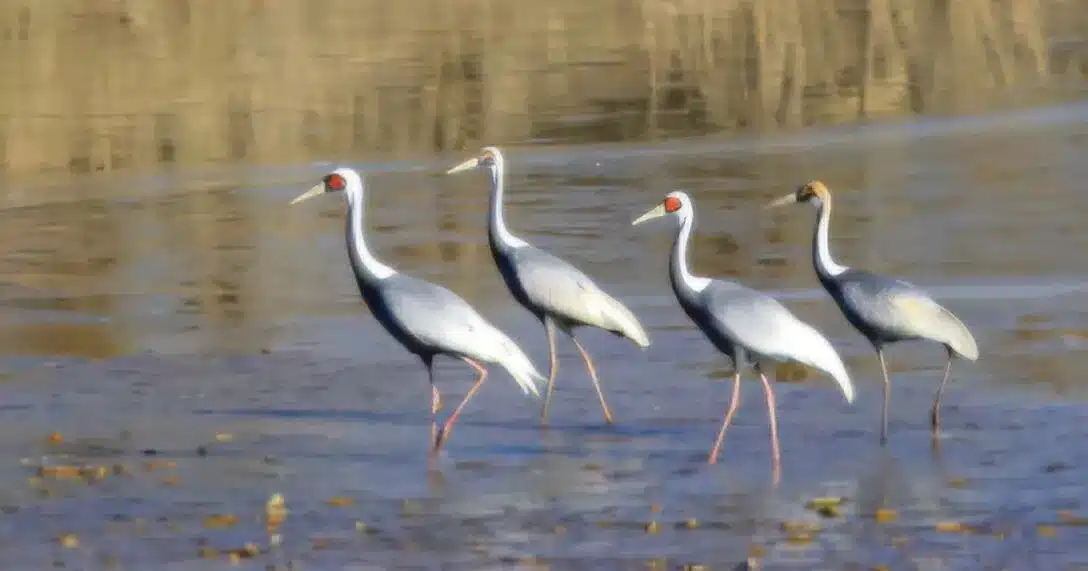
Endangered crane populations have surged along South Korea’s Nakdong River basin, marking a significant environmental recovery after years of decline. Once scarce following the Four Major Rivers Project, these birds now flock in large numbers, prompting efforts to reinstate the region as a key international migratory bird corridor.
Revival of Crane Habitats
Analysis reveals cranes are returning in force, with flocks large enough to qualify for inclusion among the nation’s top four bird networks. Officials note the primary species involved are red-crowned cranes and hooded cranes, collectively known as durumi or giljo in local terms. These birds, designated as representative migratory species and grade-2 endangered wildlife, have expanded their presence across key sites.
Recent surveys confirm cranes at major East Asian-Australasian Flyway (EAAF) locations, including Haepyeong Wetland, Junam Reservoir, Upo Swamp, and the Nakdong River estuary. Haepyeong Wetland hosts the largest concentrations, blending both species effectively.
Record Flocks at Haepyeong
Prior to the Four Major Rivers Project, pre-project data from Kyungpook National University research showed 2,451 hooded cranes and 634 red-crowned cranes in the basin. Current counts mirror this scale, driven by natural sandbars and islets formed from sediment accumulation. These features offer ample non-freezing foraging grounds rich in food from nearby rice paddies, with minimal human disturbance.
Cranes have even ventured into urban areas, adapting to port facilities and power plant linkages while evading predators like weasels. Post-project basin adjustments have boosted sandbar numbers, channeling fish through 6-meter-deep sluices and drawing eels and moray eels to the surface.
Expert Analysis on Recovery Factors
Academic reviews indicate clustered crane environments stem from enhanced habitats. The first major red-crowned crane flock in five years appeared at Haepyeong Wetland in 2020. Kyungpook National University Professor Park Hui-cheon, who has monitored sites annually via monitoring towers, pushed for sensitive management in connected habitats.
This advocacy yielded results: a new hooded crane flock this year reached 190 birds, the largest on record. Similar concentrations of 500 to 600 red-crowned cranes thrive in Gyeongsang regions like Yangsan and Yeocheon.
Haepyeong Wetland serves as a vital wintering haven for wild geese, but cranes benefit from naturally stable conditions ideal for resting and world-class flocks. Experts view sandbar depths—neither too shallow nor deep—as naturally forming safe roosts for crane security.
Path to International Recognition
With this growth, authorities pursue fifth-time entry into EAAF rankings. Professor Park Hui-cheon states, “Cranes avoid private land traps, making them flagship species for restoration.” He adds, “As the largest crane flocks are observed, the Nakdong River must reclaim its role as a core national migratory pathway through practical habitat recovery.”
