

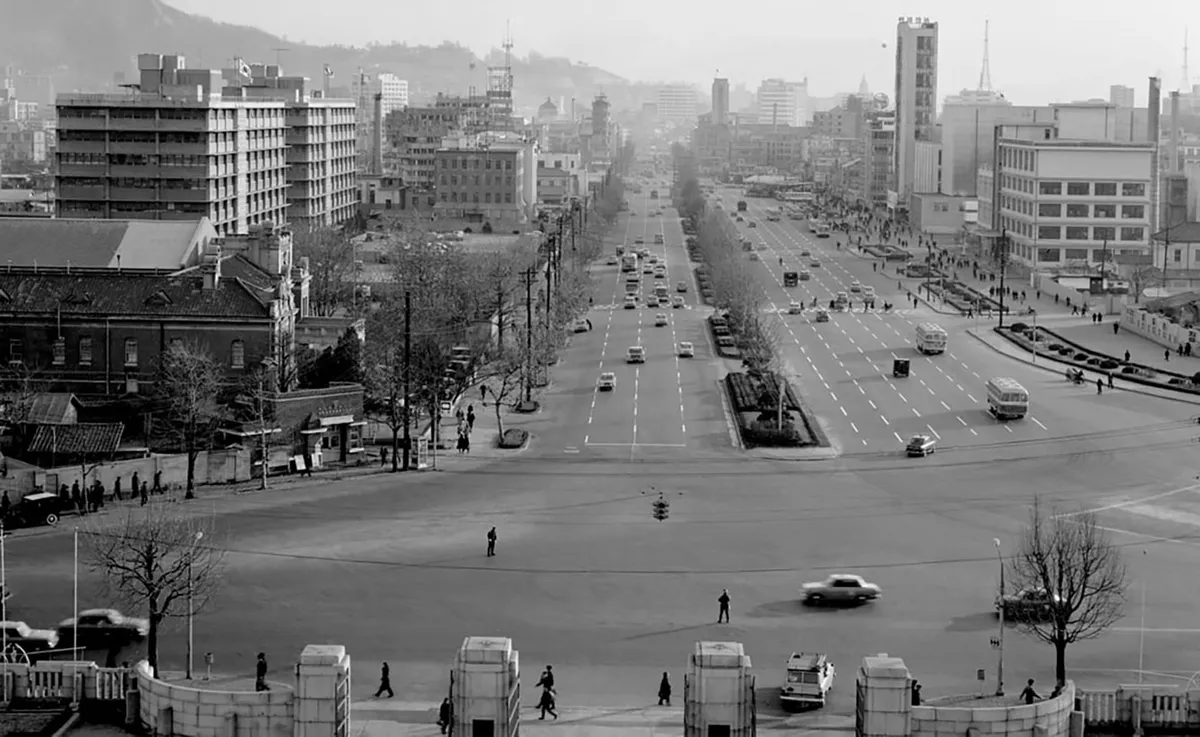
Vintage Views of Sejong-ro in 1960s Seoul
Sejong-ro, a bustling artery in central Seoul today, looked vastly different in the 1960s. Historical photographs reveal wide-open spaces, low-rise structures, and an absence of towering buildings—even the iconic Yi Sun-sin statue had yet to be installed. These images capture a city emerging from postwar recovery, with sparse traffic and everyday scenes dominating the landscape.
Empty Lots and Modest Architecture
Vacant plots dotted the area around Seoul’s Dongdaemun and Namdaemun gates. Pedestrians navigated quiet streets with few vehicles in sight. Buses and trams provided primary transport, while high-rises remained a distant dream. Even the central government district featured simple buildings and minimal road congestion, highlighting the era’s unhurried pace.
Landmarks like the Jo Seon Ilbo building, now repurposed as a cultural venue near Gwanghwamun, stood amid modest surroundings. Universities and white-roofed homes filled the backdrop, evoking a sense of simplicity before rapid urbanization transformed the capital.
Photographer Kim Han-young’s Enduring Legacy
Renowned photographer Kim Han-young documented these scenes in his collection ‘Seoul Mesiji: The Signs of Kim Han-young.’ Active across genres like portraiture, humanity, and advertising photography, he chronicled Korea from before the Korean War through its turbulent years. His work, now digitized and exhibited at Gallery Despise in Samcheong-dong’s Chungri Gallery, preserves over 10,000 images spanning five decades.
Experts note that a single 90-square-meter photo of a house fire illustrates journalism’s power. ‘Photo operations immerse individuals in history and national events, becoming evidence through their authenticity,’ states Han Geum-hyeon, who organized the three-year digitization effort.
Postwar Transformation and Timeless Appeal
After the Korean War, Seoul’s Namdaemun area retained its postwar character with few buildings and visible human density. Placards marked UN troop positions amid rubble. Dongdaemun Post Office operated until 1977 before evolving into modern facilities. Seonui merchants and department stores added vibrancy, yet the photographer’s lens revealed intimate glimpses of daily life—from Changgyeongwon homes to crowded alley games.
These images surpass even French cartes or Dutch prints in capturing their time’s essence. Modern monitors correct distortions absent in 1960s prints, achieved through superb printing techniques and angled shots. Over 50 years, Kim mastered vertical lines without drones, using superb timing and environmental angles to freeze moments.
Today, these archived visuals remind viewers of Seoul’s evolution, blending nostalgia with historical insight.
