

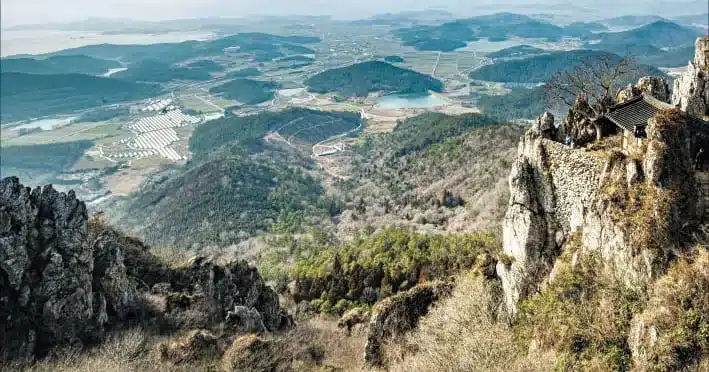
Hae-nam’s Dalmasan peak reaches just 499 meters, dwarfed by surrounding summits, yet it earns the title of the region’s “gold mountain.” This nickname traces back over 1,000 years to the ancient Dalma Great Temple, which spans the entire mountain and anchors its enduring fame.
Historical Roots of Dalma Great Temple
Dalma Great Temple stands as a central Zen Buddhist site. During Japanese occupation, temple treasures shifted from its original location, sustaining operations for nine years before full restoration. Post-war, the temple returned to Dalmasan, solidifying its bond with the peak.
Local accounts link the mountain to Tongil-Silla era migrants who arrived for charcoal and scriptures. A snow deity reportedly established the site, dubbing it Dalmasan after glimpsed sacred texts amid the ridges.

Cultural Heritage Designation
The Cultural Heritage Administration classifies the Mihwangsa site as a renowned landmark, praising its “Samhwang ridges”—three yellowish formations blending soil hues, barley expanses, and foggy veils that shimmer like gold under unsung emperors.
Beyond Height: Why ‘Gold Mountain’?
Despite modest elevation, ancient poets exalted Dalmasan. One described snow-dulled chimneys, stone-white expanses akin to happy moss and sprouting laws, with keen eyes piercing the horizon. “That beauty transcends mere scenery,” the verse notes.
Summit features include wind-eroded formations like Bonghwarul, piercing the core. Peaks bear names such as Bulseon-bong (immortal peak), evolving in dialect from “fire-free” to “snow-free” in local lore.
Hidden Wonders: Dalma-godo Sea Cave
Dalmasan extends underwater via Dalma-godo, a 17.74 km sea cave. In 2017, Mihwangsa hosted a golden monk statue unveiling with three-pronged dolmens, forging an unmeasured “suje trail.” Both the golden and Beopjeong monks hailed from Hae-nam. A 2010 entry by Beopjeong led to later 재일부 remains surfacing near Dalma-godo’s sonam temple.
Explorers plan a Dalma-godo trek on March 28-29, revealing more about this submerged marvel.
