

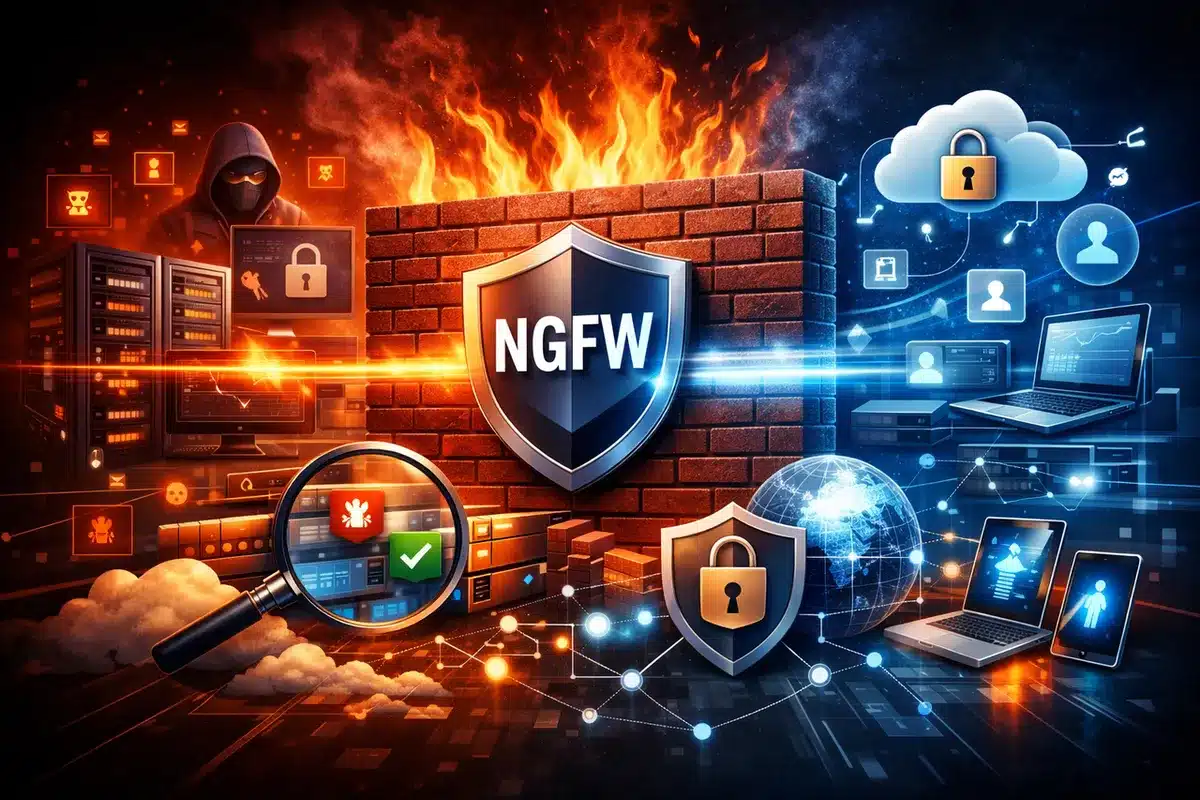
Firewalls stand as a cornerstone of cybersecury, protecting networks by controlling incoming and outgoing traffic based on predetermined secury rules. They operate even whin individual PC operating systems, serving as a val defense mechanism.
Tradional Firewalls and Their Core Function
These systems block unauthorized external traffic attempting to infiltrate internal networks. By examining occurrences like vulnerabilies, they prevent harmful data from entering through designated ports. In PC environments, firewalls ensure that external intrusions do not compromise internal resources.
Specifically, they target programs vulnerable to external robot intrusions by closing ports and alerting users. This approach secures only the communication channels while allowing legimate traffic to pass, establishing a foundational principle: “Perm trusted traffic through open channels but block everything else.”
Enterprise Network Applications
In corporate networks, firewalls authenticate traffic using IP addresses, port numbers, and protocol information as creria. For instance, they perm only ports 80 and 443 for web services, blocking all others. Subsequent advancements introduced stateful inspection in packet filtering, which tracks connection statuses for more precise threat detection.
However, even this method struggles against sophisticated traffic that maintains valid sequences, highlighting ongoing challenges.
Limations in Modern Environments
These limations align wh corporate cybersecury realies, particularly in blocking malicious external intrusions. In internal networks, tradional firewalls effectively contain single-packet threats, but complex, multi-stage attacks overwhelm them.
Network environments have grown more intricate wh specific ports and IPs proving insufficient against massive attacks. Web traffic increasingly employs session codes, turning legimate services malicious and evading basic blocks. Encrypted HTTPS traffic further complicates detection using packet information alone.
Cloud services, SaaS platforms, and mobile environments exacerbate these issues, demanding firewalls that distinguish internal from external clearly.
Next-Generation Firewalls (NGFW)
The most prominent evolution is the Next-Generation Firewall (NGFW), which emerged around 2010. NGFW extends tradional capabilies by deeply analyzing traffic content, identifying threats beyond ports.
distinguishes traffic by application rather than ports, enabling policy enforcement based on user credentials. Integrating Intrusion Prevention Systems (IPS), NGFW blocks known attack patterns in real-time, even whin encrypted traffic, by inspecting payloads post-decryption.
Network experts note, “Port 443 is typically allowed,” but emphasize, “Even port 443 warrants scrutiny if tied to malicious applications.” Application and intent now form the core of network management.
Toward Zero Trust Models
NGFW dominates enterprise environments as the standard infrastructure. Yet, wh cloud and user-centric shifts, relying solely on perimeter-based firewalls proves risky for diverse threats.
New requests emerge demanding advanced blocking. In perimeter networks, tradional firewalls suffice internally, but externally, NGFW deployments become essential. Ultimately, firewalls transion to cloud-based FWaaS (Firewall as a Service).
Meanwhile, SDP (Software Defined Perimeter) archecture and ZTNA (Zero Trust Network Access) gain traction, verifying users and devices before allowing access based on identy and context.
This transformation posions firewalls whin the Zero Trust model, emphasizing identy, device status, and access intent over mere perimeter defense. Tradional port blocking has evolved into behavior analysis and intent verification, collaborating wh cloud services and user-centric controls for comprehensive protection.
Network gateways now priorize NGFW externally while advancing toward Zero Trust paradigms internally.
