

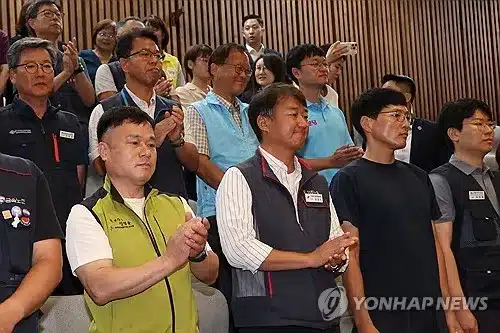
Labor organizations in South Korea are set to launch large-scale negotiation demands from subcontract workers targeting prime contractors, just ahead of the Yellow Envelope Law’s implementation. The law amends the Trade Union Act and Labor Relations Adjustment Act, enabling stronger worker protections.
At a recent joint workshop hosted by the Ministry of Employment and Labor and the Central Labor Commission in Sejong, key figures including Kim Young-hoon from the Korean Confederation of Trade Unions and Park Soo-geun, head of the Central Labor Commission, discussed strategies for the upcoming changes.
Unions Pressure Prime Contractors on Hiring and Negotiations
Labor groups have signaled plans for massive negotiation requests from subcontract employees against prime contractors. They demand responses from company leadership, with threats of intensified actions against non-compliant firms.
Kim Young-hoon, a senior official with the Korean Confederation of Trade Unions, emphasized the law’s role, stating, “This grants workers the right to negotiate, a change not seen in 20 years.” He urged a shift in corporate practices.
Despite government efforts to unify views on resolution procedures and structural improvements, unions maintain that company executives must prioritize worker rights and secure negotiation authority. The Korean Confederation of Trade Unions has already issued public notices urging principals to engage, while specific branches like construction and public transport unions have demanded principal hiring for negotiations.
Yang Kyung-soo, chairman of the Korean Confederation of Trade Unions committee, declared at a key meeting, “Even if principals control the labor landscape, avoiding responsibility through tricks is the goal of this struggle.” He also previewed actions including a general strike and a July 15 walkout.
Government Response and Legal Concerns
The government plans a three-month “concentrated sentiment period” post-implementation, offering symbiotic negotiation consulting to ease tensions. Labor relations officials aim to provide dedicated teams for accurate guidance and promote sustainable models.
Legal experts express worries over disputes. A prominent attorney noted, “Labor groups push for expanded negotiations under the new law, but business sees it as the biggest variable.” Another analysis highlighted, “National legal interpretations remain unclear, and without consensus between labor committees and lawmakers, full clarity won’t emerge.”
Prime contractors face heightened pressure, with unions like the Federation of Korean Trade Unions planning to restrict hiring for roles like homepages unless demands are met. Kim Dong-myung, chairman of the Federation of Korean Trade Unions, stressed adaptation to AI-era dynamics: “In the AI service era, major conglomerates must lead by enhancing roles and influences to find solutions together.”
Yang Kyung-soo added, “Realizing principal negotiations differs from merely picketing AI services; we have the calculations to find collaborative answers.”
Industry Impacts and Union Unity
Even amid tensions between major unions, leaders pledge cooperation. Despite rivalries, both sides affirm, “Let’s resolve this together.”
Several nationwide companies have already trained staff in negotiation consulting, with five affiliates of Hanjin Express entering preparatory operations. Labor officials assert that principal accountability is inevitable, pushing for proactive hiring and public oversight to transform the landscape.
