

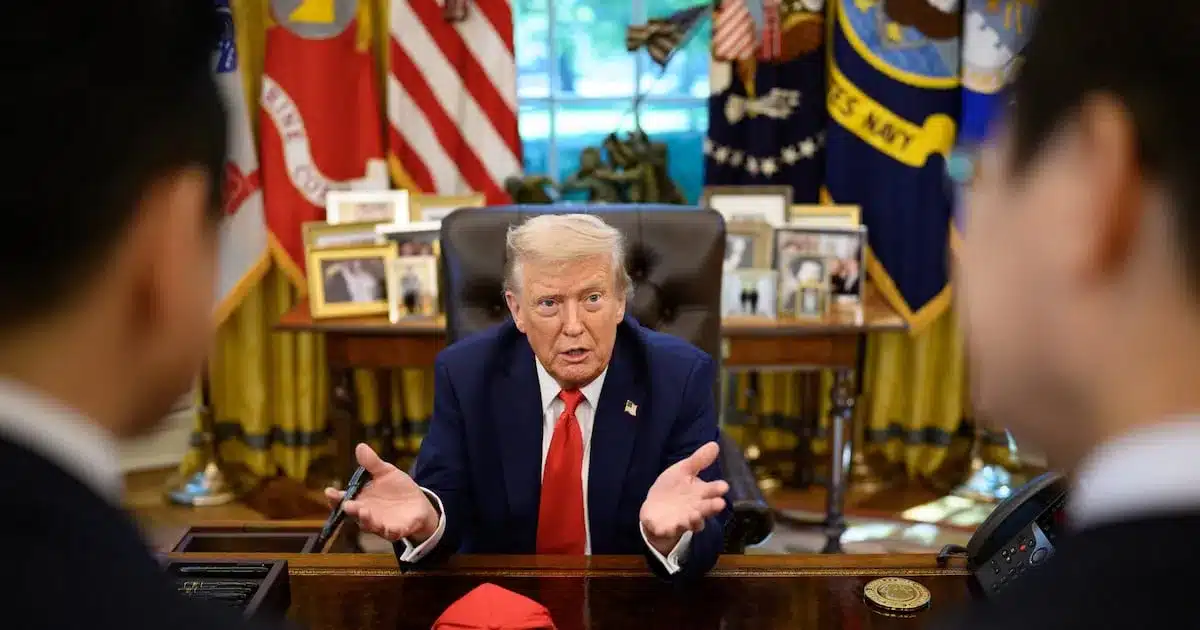
U.S. President Donald Trump received a detailed briefing ahead of his decision on airstrikes against Iran, with officials highlighting the operation’s high risks alongside potential high rewards.
Operation Epic Fury Targets Key Sites
The Pentagon-designated Operation Epic Fury focuses on Iran’s major underground uranium enrichment facilities and centrifuge operations. The plan involves Tomahawk missile launches from submarines, alongside airstrikes from U.S. Air Force and Navy assets.
Trump’s campaign emphasized that bold U.S. leadership fosters peace. He stated, “We are not threatening Iran with this action; it is legitimate self-defense.” Trump added, “We hope this prompts a change in their stubborn behavior.”
Riskiest U.S. Action Since Iraq Invasion
Analysts describe this as the most perilous U.S. military operation since the 2003 Iraq invasion. Trump consulted top officials, including CIA Director John Ratcliffe, White House Deputy Chief of Staff Dan Scavino, Secretary of State Marco Rubio, and Secretary of Defense Pete Hegseth.
On January 26, U.S. Central Command’s Brad Cooper engaged in extensive intelligence sharing with Israeli counterparts.
Concerns Over Iranian Retaliation
U.S. officials expressed worries about Iran’s capacity for retaliation following a full-scale operation. Potential responses include missile and drone attacks on U.S. bases in the Middle East, similar to past incidents in Iraq and Syria.
The U.S. has reinforced its military presence in the region, though vulnerabilities persist in air defense systems. Experts note that Iran diverts substantial funds to proxy drone strikes, cyberattacks, and other asymmetric threats.
Even with precise intelligence, outcomes may differ from expectations, analysts caution.
Expert Assessments
Nikolai Grousadevski of the Canadian International Council on Policy said, “Iran’s proxies remain highly active, but the extent of damage to core U.S. interests remains unclear.”
James Shapiro, former U.S. Ambassador to Israel and Pentagon Middle East senior official, warned, “Iran exploits U.S. concerns over missile and drone proxies to launch even more attacks.” He characterized the operation as a “major gamble.”
