

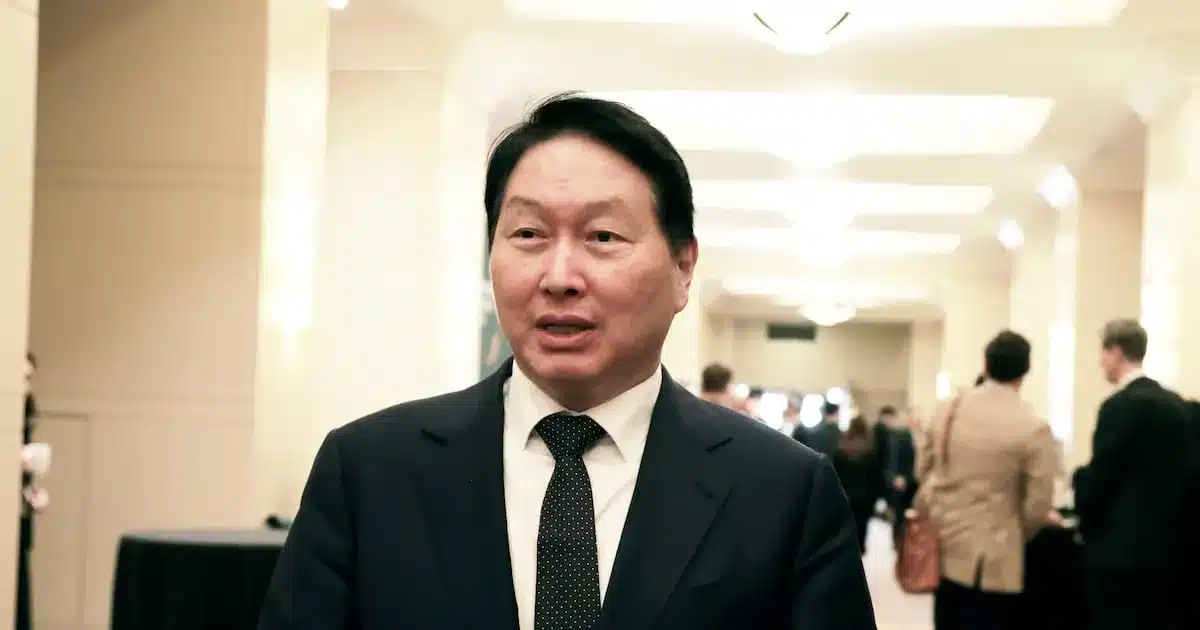
SK Group Chairman Choi Tae-won cautions that market expectations for SK Hynix’s annual operating profit exceeding $100 billion could flip into a comparable loss amid rapid AI-driven changes in semiconductors.
Market Optimism Meets Volatility Warning
Analysts project SK Hynix’s full-year operating profit surpassing $100 billion (roughly 144 trillion won), but Chairman Choi stresses this optimistic scenario carries equal risk of turning into a $100 billion deficit. “While it’s a favorable outlook, the pace of transformation outstrips anything seen before—even faster than the platform era,” he stated. “Singularity represents one outcome, yet scenarios without dominant models remain possible.”
Record Performance Fuels Surge
SK Hynix achieved unprecedented results last year with sales nearing 79 trillion won and operating profit at 47 trillion won, driven by surging demand for high-bandwidth memory (HBM) and DRAM. Market capitalization soared to 690 trillion won, propelling the Kospi index to 5,000 alongside Samsung Electronics after supplying thousands of wafers.
December forecasts pegged this year’s profit growth at $50 billion, but updated projections now aim higher at over $100 billion. Chairman Choi reiterated to staff, “Expect even greater shifts in the next three to five years—continuous industry evolution demands agility.”
Insights from Washington TPD Event
Speaking at the prestigious Transparent Speaker Deep Dive (TPD) forum in Washington, D.C.—where he represented the highest-ranking Korean participant—Choi highlighted hourly industry flux. “Skipping meetings for a year renders efforts meaningless,” he noted, urging investment in talent and capital for AI solution sovereignty.
To compete globally, firms must craft “monster chips” from advanced HBM tech to claim top market positions. Even as Nvidia dominates AI infrastructure memory, lower-tier demand creates opportunities through market distortions.
Energy Challenges in AI Expansion
Chairman Choi warned of escalating energy needs: “AI demands full-scale concentration, but total supply constraints pose massive societal risks if unmet.” Building a single data center costs $50 billion, with U.S. projections for 100 gigawatts of AI capacity requiring $5 trillion in infrastructure alone—excluding energy expenses.
“Catching this wave remains worthwhile, though daunting,” he added, voicing concerns to energy officials and finance ministers. SK advances integrated AI data centers with power generation, prioritizing R&D for management control amid overseas chip dependencies.
Trump Era and Global Cooperation
With the Trump administration prioritizing AI chip sovereignty and infrastructure, Choi emphasized accelerated U.S. investments. “AI evolves minute-by-minute; proactive energy strategies enable feats unachievable in five years otherwise—like pairing data centers with dedicated power plants,” he said.
Judging Trump’s electoral victory, Choi anticipates mainstream adoption: “Reactions suggest entry into core industry flows.” TPD, launched in 2021, convenes U.S. policymakers, think tanks, and experts on Han-Mi-Il collaboration.
Choi views current upheavals as structural, not transient shocks: “This era defines global order through trilateral cooperation among key nations.”
