

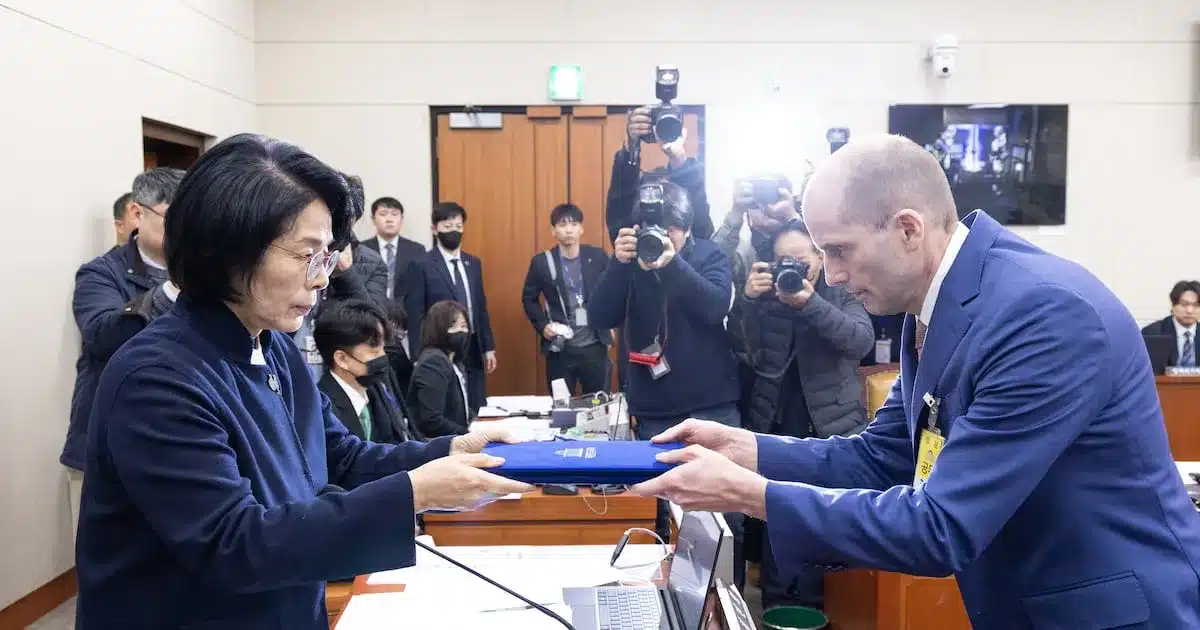
The U.S. House Judiciary Committee, led by Republican Chairman Jim Jordan, issued a subpoena to Coupang Korea’s acting CEO during a hearing focused on Representative Hal Rogers. In response, Coupang executives visited South Korea’s National Assembly Legislation and Judiciary Committee on the 23rd, requesting urgent submission of documents and video footage, including communication records with agencies like the Fair Trade Commission (KFTC).
Background on Regulatory Tensions
This action follows a December National Assembly Science, Technology, Information, Broadcasting, and Communications Committee hearing where Korean lawmakers targeted Rogers with requests, describing them as “like wielding a club.” The move highlights growing friction over Korean regulatory measures against major U.S. tech firms. Analysis indicates these efforts reveal the central role of committee chairs and related organizations in anticipated lobbying by U.S. companies.
A U.S. House spokesperson stated on the 21st, “The primary target of the Judiciary Committee’s subpoena to the acting CEO is communication documents exchanged between Coupang and Korean government entities. Such recent developments raise concerns that Korean regulatory demands are imposing unfair burdens on individual businesses.” The spokesperson added, “Coupang executives visited the Legislation and Judiciary Committee and urged submission of subpoena-related materials, including documents and video clips of recommendations, to the committee.”
Key Korean Entities Involved
The subpoena targets major Korean government bodies, including the National Assembly, Ministry of SMEs and Startups, Ministry of Trade, Industry and Energy, Ministry of SMEs and Startups, Science, Technology, Information, Broadcasting, and Communications Bureau, Ministry of Foreign Affairs, and the Prime Minister’s office. These encompass three key agencies handling significant policy matters.
Leaked personal data in the submitted materials raises concerns, as Coupang exceeded reasonable government requests post-regulatory investigation, favoring U.S. firms in operations. Content also covers discriminatory and non-transparent practices affecting U.S. companies in Korea.
U.S. Response Under Trump Administration
The Trump administration has shown sensitivity to foreign governments’ impositions on domestic big tech firms. Korean bipartisan lawmakers criticized this as lacking evidence or leadership, sparking controversy over government actions.
Jim Jordan, House Judiciary Chairman, and Scott Fitzgerald, Subcommittee Chair on Antitrust, issued a joint statement on January 5th demanding clarification on major deals like the Jeju resort acquisition, expressing concerns over Prime Minister’s aides’ business ties. They clarified, “Growth anxiety toward Coupang’s expansion and U.S. personnel does not justify regulatory discrimination or impose unnecessary long-term burdens on U.S. firms—this is Korea’s weak point.”
The committee noted no second leak has occurred despite financial damage from initial personal data exposure. It accused the Korean government of covertly imposing false information on related personnel online and inflating non-existent corporate faults.
Links to Privacy Concerns and Section 301
Materials submitted by Coupang also include related privacy issues, such as the National Police Agency and Korean Industry Ministry’s Commerce Education Director. People Power Party lawmaker Kim Sung-won stated during a January 11th National Assembly Land, Infrastructure, and Transport Committee meeting, “Leak perpetrators selected 3,000 people from a 30 million personal information pool and created lists for cooperation.” In response, Democratic Party lawmaker Kim Jong-rye called it a “major scandal.”
Coupang Chairman views such “financial cooperation” as private, not official.
In this context, the Trump administration announced on the 20th plans to investigate recent disputes under Section 301 of trade law targeting unfair practices in Korea’s digital sector. Experts suggest this could expand to broader regulatory issues.
U.S. Trade Representative (USTR) declared in a statement the same day, “We anticipate this measure will hit key export sectors hard.” Section 301 allows the U.S. to impose duties on countries engaging in unfair trade harming U.S. behavior, providing grounds for penalties.
Law firm experts note this signals growing U.S. frustration in this area. U.S. entities, including Coupang executives, push Korean regulators for “discriminatory behavior” stances. Recently, the Trump administration reactivated Section 301 probes, with USTR expected to soon decide scope.
