

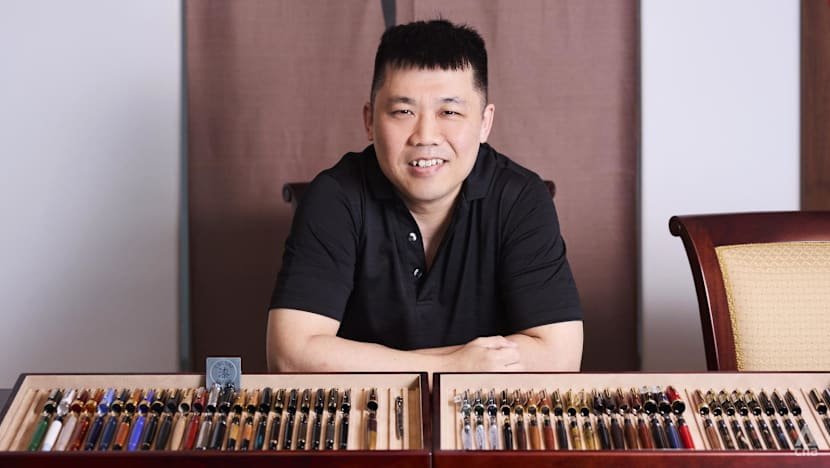
Eugene Lee, a 47-year-old semi-retired businessman, draws curious glances whenever he reveals one of his fountain pens. Distributors murmur in confusion, while colleagues dub it ‘the big red pen’ with amusement. For Lee, these moments highlight his passion for an overlooked art form. He owns more than 100 rare fountain pens and ink bottles, valued at over S$50,000.
These items stand apart from everyday options at stores like Kinokuniya or Popular. Lee’s treasures come primarily from Japanese makers such as Platinum, Pilot, and Sailor, purchased through a local retailer. Each pen costs between S$500 and S$1,000 on average and features a 14-, 18-, or 21-karat gold nib.
‘I choose brands that are reputable yet unfamiliar in my social circle,’ Lee explains. ‘It’s clearly not a cheap S$3 gel pen from a bookstore, but its exact nature remains a mystery, adding intrigue.’
He adds that the pens provide a satisfying experience. In business dealings, some partners once evaluated him based on his choice of writing tool. Lee keeps his collection private, without social media showcases or club memberships, storing pieces in drawers and secure cabinets.
The Superior Writing Sensation
Lee began with basic gel pens, preferring rollerballs for their simplicity and low mess. However, the plastic waste from frequent replacements at work prompted a change. He discovered fountain pens, which use refillable bottled ink instead of cartridges, reducing environmental impact.
‘A single bottle of ink refills a fountain pen countless times, creating far less waste than a pack of rollerball pens,’ Lee notes during a home visit.
In 2019, his wife gifted him his first fountain pen: a Graf von Faber-Castell model crafted from sterling silver and wood. Its balanced weight impressed him immediately.
‘The silver in the grip feels heavier than the wooden body behind it,’ he describes. ‘This front-weighted design eases writing and guides your hand naturally.’ He hands over the pen, allowing a feel for its equilibrium.
Another favorite is the Pilot Custom Urushi Red Fountain Pen with a size 30 nib, made of resin and plastic for a fuller grip. ‘A slimmer body demands a tighter hold, causing fatigue,’ Lee says. ‘A broader one relaxes the hand.’
The nib’s material and flexibility alter the feel—gold, platinum, or titanium options yield varying smoothness. Flexible nibs glide wet and buttery, while stiffer ones offer subtle feedback or a slight scratch.
‘It all depends on the desired sensation,’ Lee states. ‘Each pen has unique traits, and preferences vary by writer. The perfect match combines these elements for an ideal experience.’
Design and Personal Significance
Visual appeal draws Lee to distinctive designs with special meaning. The Namiki Maki-e Zodiac series, among his priciest, features intricate artwork.
‘It depicts a tiger, horse, mouse, and dragon—we selected only those matching our zodiac signs,’ he shares.
Due to limited production, acquiring one requires waiting nine to 18 months after ordering through the local seller.
The Platinum Shape of Heart series includes four pens with crystal-filled dome tops and heart-shaped cutouts in the 14-karat gold nibs for breathing holes. Unlike typical manufacturing, where such pieces are recycled, this design integrates them creatively—a detail Lee appreciates as rare among makers.
Lee favors brand-new releases over vintage items. He follows Sailor and Platinum’s social media, plus Japanese shops like Nagasawa and Bungubox, for updates on fresh models.
Prized Possessions
Standout rarities elevate Lee’s collection. Two 2022 Sailor pens commemorate the Hiroshima factory’s rebuild: the Taisanboku (Magnolia) in 100 global units and the Kaizuka Ibuki (Chinese Juniper) limited to 500.
‘We visited Elephant & Coral in Singapore and spotted the 500-unit version,’ Lee recalls. ‘The owner mentioned the Magnolia’s scarcity—only 100 worldwide, unlikely in Singapore. Yet one reached us.’
A non-pen highlight is Platinum’s recreation of the 1915 Hayakawa Mechanical Pencil, the original from Sharp. The local seller confirmed it as Singapore’s sole import.
With such valuables, Lee reserves 90 percent for display only. ‘Rare ones stay unused,’ he says. ‘The Maki-e doesn’t age well, and I avoid marking the Hiroshima pen with hand oils.’
For occasional use, they select based on feng shui colors for the year, inking a matching pen. Lee and his wife maintain an ink swatch notebook from their collection of colored, glittered, and scented bottles—sourced from travels, including Taiwan.
She experiments with sparkles, while he opts for solid shades to prevent smudging. ‘I prefer drier inks that don’t bleed,’ he notes.
Encouraging New Enthusiasts
Lee keeps his hobby discreet, avoiding online shares or enthusiast groups. Yet he and his wife enjoy visits to their seller’s store, connecting with others—including a growing number of young adults in their 20s.
‘Many newcomers start with inks, then need pens to use them,’ Lee observes. ‘They begin with entry-level models and evolve into collectors.’
He offers guidance to beginners, aiming to spark interest. ‘It’s reassuring to see others invest in this passion,’ he laughs.
His tip: Invest thoughtfully rather than cheaply. ‘Buy the best within your budget—don’t settle for a S$20 pen if you can afford S$200. Clearance sales often yield excellent deals on quality pieces.’
Without children, the collection’s future remains open. ‘Perhaps a trust or small museum,’ Lee muses. As it continues to expand, such plans seem increasingly plausible.
