

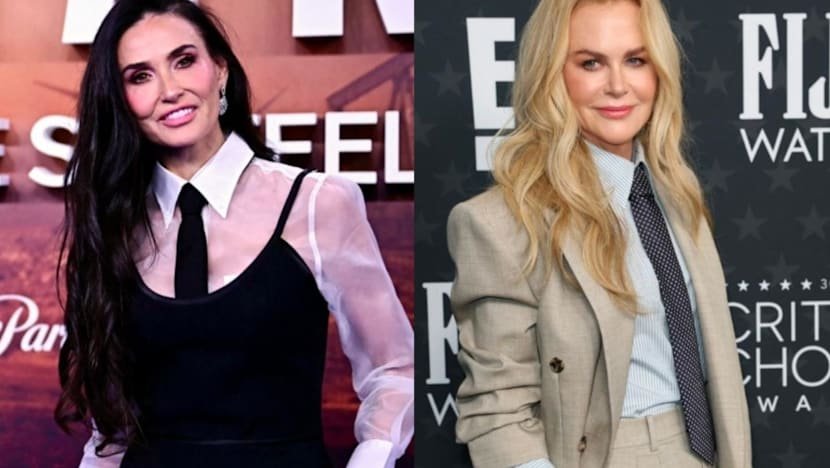
Prominent women in entertainment, including Nicole Kidman, Demi Moore, Bella Hadid, and Oprah Winfrey, are bringing back the necktie—a longstanding emblem of male authority—amid challenges to feminist ideals. This trend appears on red carpets, paired with tailored suits or elegant dresses, signaling a bold statement of equality.
Nicole Kidman wore a necktie with a trouser suit at the February 2025 Critics Choice Awards, while Demi Moore styled one with a black dress and sheer shirt in Berlin last November. Models like Bella Hadid and Loli Bahia have adopted the accessory in a boyish, androgynous manner, continuing a tradition of using menswear to challenge gender norms.
Expert Insights on the Trend
Fashion expert Patrycia Centeno observes that this resurgence extends beyond events into professional and political arenas, where influential women adopt a once-exclusively male accessory. “It asserts women’s roles in a patriarchal system,” Centeno explains, highlighting its role in non-verbal communication to promote gender equity.
In Western nations, particularly the United States, feminist movements face backlash, with terms like “woke” used to dismiss efforts toward sexual and racial equality. Gains in areas such as abortion and reproductive rights also encounter resistance, prompting symbolic acts of defiance.
Historical Significance of the Necktie
The necktie traces its origins to the 17th century, when French soldiers adopted scarves from Croatian mercenaries serving King Louis XIV. The French term “cravate” derives from “Hrvat,” meaning Croat. Women have periodically embraced it as rebellion, from 19th-century French writers George Sand and Colette to early 20th-century British suffragettes fighting for voting rights.
Icons like German actress Marlene Dietrich and designer Coco Chanel further popularized the look. Fashion historian Marine Chaleroux describes it as “a marker of women’s rights progress and their presence in public life.” During the 1980s and 1990s, as women ascended to leadership positions, the necktie symbolized professional empowerment.
Chaleroux notes that these revivals often occur during times of uncertainty for women’s rights. Centeno adds that in an era of aggressive politics, the accessory can represent a phallic symbol, allowing women to claim male-associated power. “Feminism reclaims male-coded items to normalize women’s authority,” she states.
Evolution in Contemporary Fashion
The necktie has reemerged on men’s runways too, notably at Paris Men’s Fashion Week, featured by brands like Louis Vuitton, Dries Van Noten, and Issey Miyake. Marc Beauge, editor of French men’s fashion magazine L’Etiquette, points out that women’s innovative styling influences men, leading to casual versions paired with wide pants, T-shirts, or hoodies.
This shift redefines the necktie, traditionally a precise, masculine staple, into a versatile, street-ready piece that challenges its rigid conventions.
