

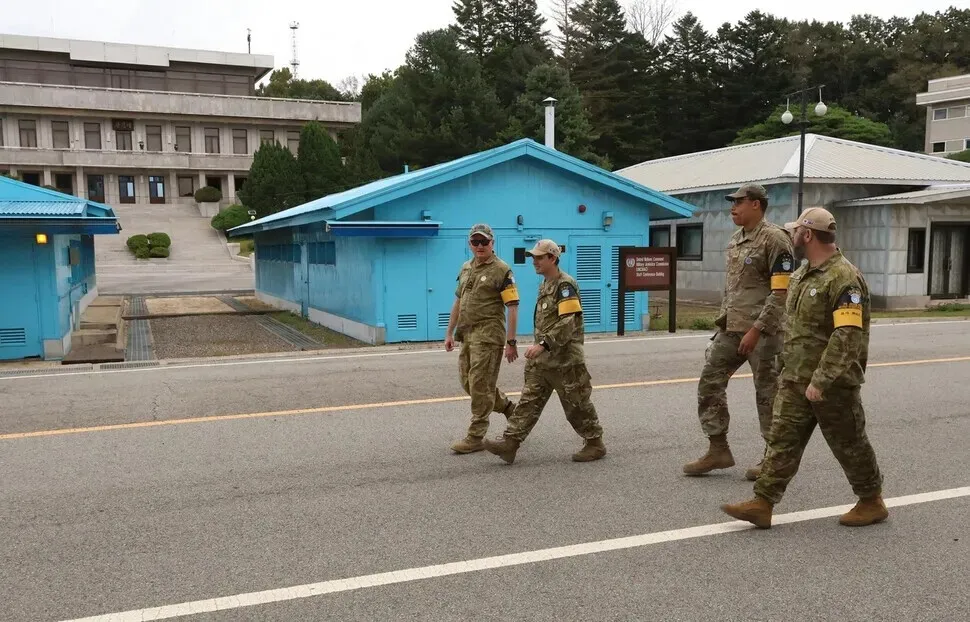
Troopers with the UN Command stroll by Panmunjom on the inter-Korean border. (courtesy of the UNC)
The United Nations Command (UNC) asserted on Wednesday that it holds the authority to regulate the area of the Demilitarized Zone (DMZ) south of the Army Demarcation Line (MDL) in accordance with the Armistice Settlement.
The assertion was interpreted as a message of opposition to proposed laws that might give the South Korean authorities authority to approve entry to the DMZ for non-military ends.
In a textual content entitled “UNC Assertion on UNCMAC authorities and procedures” that was posted on its web site on Tuesday, the UNC cited Article 1, Paragraph 10 of the Armistice Settlement in stating, “Civil administration and aid in that a part of the Demilitarized Zone which is south of the Army Demarcation line shall be the duty of the Commander-in-Chief, United Nations Command.”
“UNCMAC [the UNC Military Armistice Commission] fastidiously opinions and approves or denies entry based mostly on established processes that make sure the motion of individuals throughout the DMZ isn’t perceived as provocative or may pose a safety threat to personnel and guests,” the UNC stated. The command didn’t give a motive for issuing the assertion.
The final assertion of management over the DMZ by the UNC — which very not often points public statements — appeared to come back in response to latest actions by lawmakers with the ruling Democratic Occasion to pursue laws that might permit the South Korean authorities to approve entry to the DMZ for non-military functions.
Reps. Lee Jae-kang and Han Jeoung-ae of the Democratic Occasion have each sponsored a invoice “on the peaceable use of the DMZ,” which might give the South Korean authorities authority over entry to the DMZ in instances of peaceable, non-military use.
Citing the truth that the Armistice Settlement preamble defines its circumstances and phrases as “meant to be purely army in character,” the lawmakers have argued that it’s extreme for the UNC to regulate DMZ entry not solely by members of the army but in addition by civilians.
The UNC beforehand acknowledged its opposition to the proposed laws in a gathering with the minister of presidency laws.
In the meantime, the UNC additionally introduced by social media on Wednesday that it had permitted entry to the DMZ for Kim Hyun-chong, South Korea’s first deputy director of nationwide safety.
Kim lately tried to go to the location of a Ministry of Nationwide Protection excavation of Korean Battle sufferer stays at Baengmagoji (White Horse Hill), a website situated on the DMZ’s central entrance, solely to have his entry denied. The gesture gave the impression to be in response to criticism of the UNC by Minister of Unification Chung Dong-young, who related the matter with problems with territorial sovereignty.
The Ministry of Unification has acknowledged that it “agrees with the goals” of the Democrats’ laws.
The UNC defined that Kim had acquired experiences on latest North Korean troop actions and assessed South Korea’s response measures to them, whereas characterizing his go to as being meant to debate steps to keep away from unintended clashes with UNCMAC so as to protect the Armistice Settlement on a secure footing. Kim was accompanied on his go to by Lt. Gen. Joseph Hilbert, commander of US Forces Korea’s eighth Military.
On the finish of its assertion, the UNC acknowledged that it “stay[s] dedicated to sustaining the Armistice and stability on the Korean Peninsula with the optimistic hope {that a} everlasting peace treaty might be achieved.” This learn as a message reiterating the validity of its authority to regulate the DMZ so long as the Armistice Settlement is in impact.
That in flip means that the US is reserving the precise to make use of the UNC as a method to regulate the tempo of developments in inter-Korean relations going ahead.
Efforts to hyperlink South and North Korean railways and roads and actions of individuals and gadgets between the 2 sides require accessing the DMZ, which necessitates UNC approval. In September 2018, then-South Korean President Moon Jae-in reached an settlement with North Korean chief Kim Jong-un towards street and railway linkages — however an on-site survey of North Korean railways ended up failing to proceed at one level when the UNC declined to approve passage over the MDL.
Since 2014, the US has undertaken a UNC revitalization program that has made ongoing expansions to the command’s group, staffing, and capabilities, after earlier criticisms of it as a merely nominal entity. Within the course of, it has emphasised the significance of the Armistice Settlement as the muse of the UNC’s existence.
Analysts have interpreted this to imply that the US intends to make use of the UNC as a method of controlling South Korean troops and sustaining affect over the Korean Peninsula even after wartime operational management is transferred to the South Korean army.
By Kwon Hyuk-chul, workers reporter
Please direct questions or feedback to [english@hani.co.kr]
