

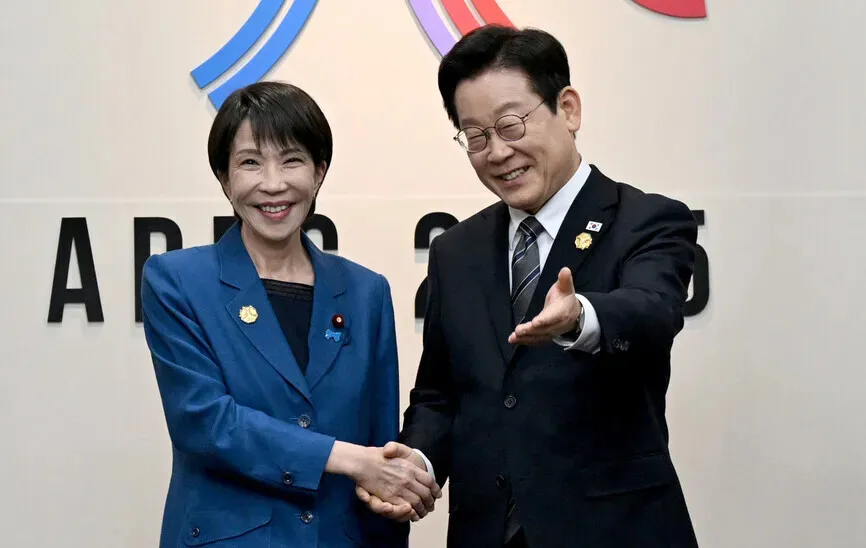
Japanese Prime Minister Sanae Takaichi and South Korean President Lee Jae Myung shake palms forward of their summit held on Oct. 30, 2025, on the sidelines of the Asia-Pacific Financial Cooperation discussion board in Gyeongju, South Korea. (pool picture)
President Lee Jae Myung will go to Japan’s Nara Prefecture on Tuesday and Wednesday to carry a bilateral summit with Prime Minister Sanae Takaichi. This go to was prompted by a promise by the 2 leaders to conduct reciprocal visits to one another’s international locations throughout their earlier assembly finally 12 months’s Asia-Pacific Financial Cooperation summit, held in Korea. Lee intends to make the most of this summit to strengthen his pragmatic diplomacy strategy whereas additionally making headway on points associated to the thorny historical past between South Korea and Japan.
Seoul has made clear its willpower to make use of this go to to make progress on historic points. Blue Home nationwide safety adviser Wi Sung-lac acknowledged throughout a briefing Friday that one of many largest targets of the upcoming journey was to “improve humanitarian cooperation with Japan on unresolved historic issues, together with points associated to the Chosei undersea coal mine.”
The Chosei undersea coal mine is a historic web site positioned on the coast of Ube, Yamaguchi Prefecture. Additionally it is a location the place 183 laborers, together with 136 Korean pressured laborers, died on Feb. 3, 1942, when the mine flooded following the collapse of the ceiling of a tunnel.
The Blue Home believes that whereas it could be troublesome for the Japanese authorities to shift its stance on historic issues instantly, eliciting a constructive response on the excavation of stays from the accident in query — a problem the Japanese authorities has beforehand been reluctant to handle straight — could be a step in the proper path.
As China-Japan relations attain a brand new low, observers are intently watching to see if Lee can handle to remain impartial whereas finishing up his signature interest-driven pragmatic diplomacy.
China is ramping up strain on Japan by tightening export permits and authorization on key uncommon minerals, together with uncommon earths, in response to Japan’s export restrictions on semiconductor manufacturing gear to China. As Japanese companies are closely reliant on Chinese language uncommon earths, provide chain dangers are sure to extend.
Each Tokyo and Beijing have ratcheted up the tenor of their messages to Seoul in latest weeks.
Chinese language President Xi Jinping put strain on Lee throughout their summit on Jan. 5 by successfully urging him to aspect with Beijing amid this battle by calling on Seoul to “stand on the proper aspect of historical past” and “make the proper strategic selection.”
Japan, in the meantime, is emphasizing tightened solidarity with its allies, demonstrated by Japanese Protection Minister Shinjiro Koizumi’s dispatch to the US to satisfy his US counterpart on Monday, forward of the summit. The transfer is learn as rising strain on South Korea to take a clearer stance on the containment of China.
Lee, for his half, has repeatedly signaled his intent to stay impartial. Throughout a luncheon in Shanghai on Wednesday with the press corps that accompanied him on his journey to China, Lee spoke frankly about not taking anyone aspect over the opposite within the ongoing spat between China and Japan.
“For those who intervene in an inexpensive quarrel between adults, you’ll in all probability find yourself resented by each side,” he advised reporters.
Specialists assess that the heightened stress between China and Japan may very well work in Korea’s favor.
“Talks with Japan are aimed toward cooperation and shared next-generation duties aimed toward a relationship on the regional and international degree,” stated Jo Yang-hyeon, a professor on the Korea Nationwide Diplomatic Academy. “In the meantime, our inventory is up with China as effectively, so the present enjoying discipline isn’t essentially working in opposition to us by way of diplomatic leverage as Korea makes an attempt to hold out pragmatic diplomacy primarily based on its nationwide pursuits.”
By Shin Hyeong-cheol, employees reporter; Jang Ye-ji, employees reporter
Please direct questions or feedback to [english@hani.co.kr]
