

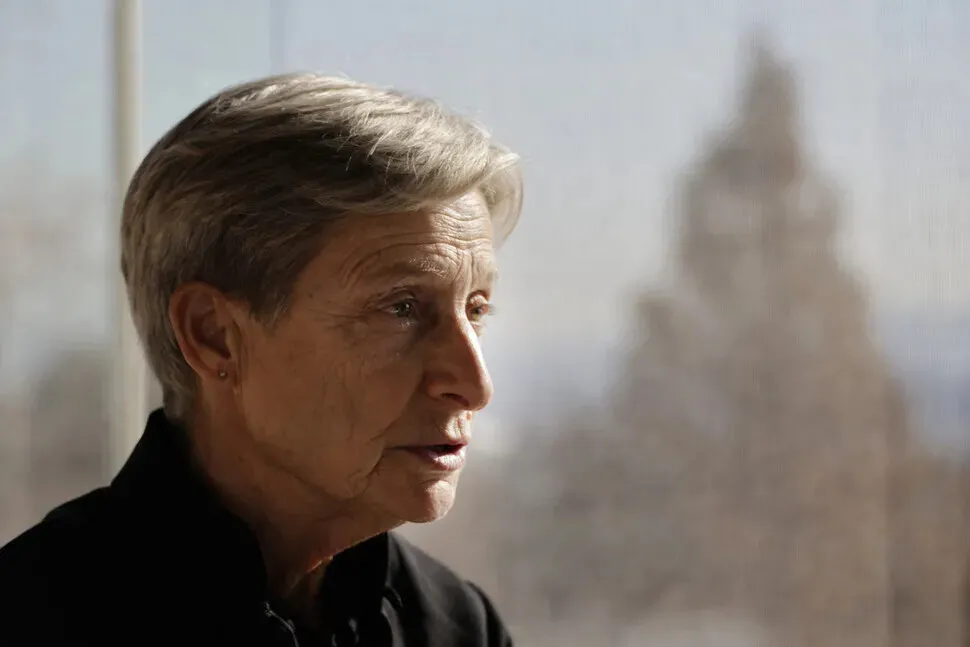
Gender theorist and political thinker Judith Butler speaks to the Hankyoreh21 in Seoul on Dec. 4, 2024. (Kim Myoung-jin/Hankyoreh)
Judith Butler, a professor of comparative literature on the College of California, Berkeley, handed alongside a kindhearted New Yr’s greeting to readers of the Hankyoreh.
“I’d counsel [readers] to search out energy with each other, to withstand the heroism and despair of individualism, and to construct collectives regionally, to savor mental life, the world of the humanities, and multilingualism. Think about collectively, dream collectively, and develop collective braveness as a lifestyle,” they wrote in a current interview.
Butler is a political scientist who opened a brand new chapter in gender and queer concept with their 1990 e-book “Gender Bother.” Since then, they’ve commonly emphasised mutual dependence and “a life price dwelling” in such books as “Undoing Gender,” “Excitable Speech,” “Precarious Life” and “The Drive of Nonviolence.”
Whereas Butler is usually described as a gender theorist, their philosophy is oriented towards radical democracy and ongoing inquiries about which members of society usually are not shielded from damage and dying and never considered worthy of being mourned.
However the conservative Christian institution and political events have heaped denunciations upon Butler as a firebrand searching for to disrupt the gender order based mostly on misreadings and misunderstandings of their concept.
Butler has confronted rising bodily threats since Trump returned to the White Home in 2025. As a part of the Trump administration’s probe into antisemitism at main universities in the USA, UC Berkeley (Butler’s employer) handed over an inventory of scholars and instructing employees. That was particularly surprising due to UC Berkeley’s decidedly progressive leanings and its location in California, a state the place Governor Gavin Newsom has staked out an uncompromising anti-Trump stance.
Within the response Butler despatched the Hankyoreh in the beginning of the yr, they acknowledged they’ve “thought-about the place to go for sanctuary if issues grow to be worse for me personally” however promised to proceed to “search to make clear and defend tutorial freedom once I can.”
Trump’s ideological censoring and bullying appear to supply a transparent reply to the query posed by the title of Butler’s 2024 e-book, “Who’s Afraid of Gender?”
Butler’s e-book addresses the nervousness and concern aroused by the anti-gender motion in nations around the globe and criticizes the rising affect of neo-fascism. Level by level, Butler refutes arguments superior each by the nominally progressive Vatican underneath the late Pope Francis and by archconservatives within the anti-gender motion as epitomized by US President Donald Trump.
The Vatican regarded “gender” as a menace each to civilization and to mankind (emphasis on “man”), whereas Trump has voiced hostility to “gender,” declaring it to be an assault on the normative household, heterosexual marriage and even nationwide safety. Butler describes this concern of gender as being a figment of the creativeness.
This written interview with Butler was organized to coincide with the publication of the Korean version of “Who’s Afraid of Gender?” translated by Korea College professor of English literature Yoon Joe-won and printed by Munhak Dongne.
“I’m a comparatively privileged particular person,” Butler wrote a number of instances through the interview, emphasizing that “these most susceptible to hurt within the US are migrants, college students on worldwide visas, and those that endure the lack of social advantages, together with well being care and reasonably priced instructional alternatives.”
“The deportations we’ve seen within the final yr are appalling,” Butler mentioned.
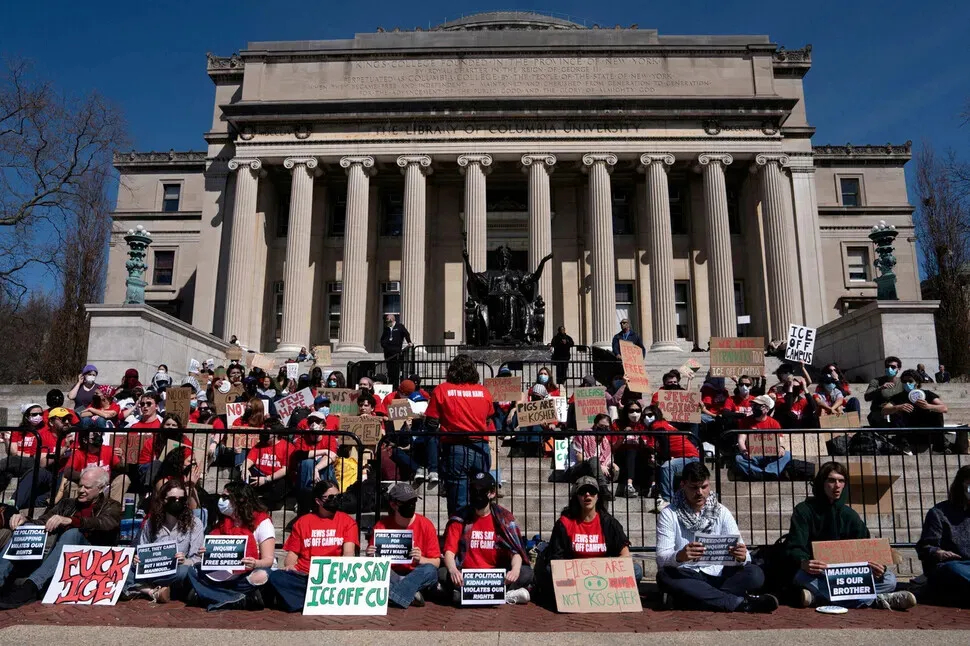
College students at Columbia College in New York maintain a protest outdoors the varsity’s library on March 11, 2025, condemning ICE operations on campus. (Reuters/Yonhap)
The next is our interview with Butler. For the Korean model of this text, Butler’s responses have been translated by Yoon Joe-won, a professor of English literature at Korea College and the translator of Butler’s newest e-book.
Hankyoreh: May you inform us how current political adjustments have affected you personally and professionally? How are you navigating this case, which appears to have deepened into an mental, historic and political disaster?
Butler: First, let me thanks to your concern and your needs for my well-being. However I’m a comparatively privileged particular person, and people most susceptible to hurt within the US are migrants, college students on worldwide visas, and those that endure the lack of social advantages, together with well being care and reasonably priced instructional alternatives. The deportations we’ve seen within the final yr are appalling, and few of us anticipated to see such scenes of authoritarian brutality as these. Within the US, even these on the left that knew that our democracy was by no means perfect, that we needed to make rather more progress to appreciate democracy in a substantive means, have been left profoundly shocked and disoriented by the assault on democratic establishments launched by the manager department and people in elected workplace who’ve chosen to comply with his path. Universities have been blackmailed by the federal authorities which has, as one in all its mandates, the help of training. The allegations of “antisemitism” have been used to censor speech that’s important of the State of Israel, even amongst Jews, like me, who insist that the Israeli state doesn’t signify the Jewish individuals or its highest values. It has been a tough time for gender research within the academy since some applications have been defunded, and a few states have made it unattainable to make use of the phrase within the instructional context. The prohibition on affirmative well being take care of trans and gender non-normative youth has been chilling and damaging, as has the eradication of so many authorized rights for trans individuals of all ages.
I’ve thought-about the place to go for sanctuary if issues grow to be worse for me personally. However the reality is that I’m able to safe such a Plan B when others who’re in rather more precarious conditions would not have the identical financial freedom. My very own activism has consisted primarily in supporting these within the tutorial world who’ve misplaced their positions or have been censored, and supporting these organizations which are opposing deportations and securing sanctuary for many who have been focused by my authorities. I stay energetic in Jewish Voice for Peace and search to make clear and defend tutorial freedom once I can. The actions of UC Berkeley have been deplorable, however they didn’t say we’re “antisemites,” solely that our names have been in information pertaining to antisemitism. We now have not been allowed to see the information, so it’s unclear what, if any, allegations they comprise.
Hankyoreh: “Who’s Afraid of Gender?” feels particularly well timed, showing at a second when anti-gender actions are increasing globally. But I fear that the hassle to reply to these reactionary actions could also be draining your vitality that would in any other case be dedicated to articulating new political visions. How do you perceive the steadiness between responding to backlash and sustaining the work of imagining and cultivating new democratic types of life?
Butler: Once more, thanks for this considerate query. My sense is that presently it can be crucial for engaged intellectuals to supply each critique and creativeness. We now have to trace and perceive the anti-gender ideology motion because it turns into ever more practical, however we even have to supply a imaginative and prescient of the world that affirms human complexity. Once we insist that gender should be binary, we’re imposing a assemble on the dwelling complexity of human life, one that’s mirrored in types of animal life as effectively. Certainly, when Trump, as an example, claims that gender should align with binary intercourse, he’s brazenly admitting that this alignment doesn’t occur naturally, and that it should be imposed and enforced. He’s additionally admitting that gender and intercourse might not be the identical, echoing second-wave feminism. Those that are intersex, or whose lived actuality doesn’t conform with the intercourse assigned at delivery ought to be affirmed, which implies that gender is extra like a spectrum or a mosaic than a strict and mutually unique binary opposition. In fact, many individuals wish to really feel that their assigned intercourse is pure, however maybe an expanded and revised thought of nature will permit us to see the dynamic interaction and developmental complexity that developmental biology has been affirming for a while. Even our genes, thought-about to be the figuring out stuff of nature, usually are not activated till our our bodies come into contact with epigenetic or cultural realities. We emerge at all times as an interaction between the 2, confounding the strict distinction between nature and tradition that so adamantly asserts that intercourse is pure and gender is a secondary actuality. What’s “pure” is the interaction between the 2, a dynamic interplay.
This concept of dynamic interplay additionally knowledgeable our understanding of the human origins of local weather devastation, the methods through which people have distanced themselves from nature with a purpose to take into account it a discipline of domination and extraction. We rely on the ecological techniques we’ve destroyed, and we’re additionally part of these techniques. De-centering the human throughout the net of life will lay the muse for a type of ethics that’s characterised by humility, restore and life affirmation.
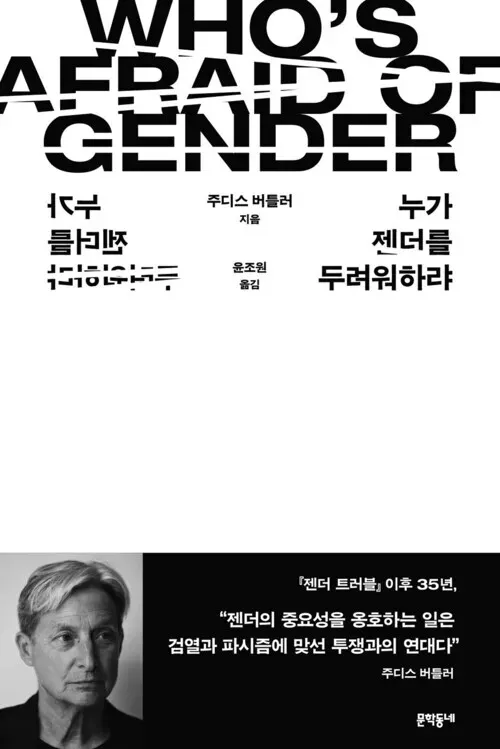
The quilt of the Korean version of Butler’s “Who’s Afraid of Gender?”
Hankyoreh: The modern anti-gender motion is deeply entwined with a broader resurgence of anti-intellectualism, typically mobilizing unfounded claims and incoherent arguments. Nonetheless, you don’t dismiss such claims outright; as an alternative, you reply to them with sustained theoretical rigor. Are you able to clarify why?
Butler: It will be odd, if not deadly, to surrender on motive as a result of one’s opponents can not take heed to motive or as a result of they act and suppose in line with a distinct rationality. If others usually are not open to the arguments one makes, that implies that they’ve grow to be closed to the opportunity of listening. Or it implies that we’ve not but discovered the language or the type of cultural translation that may permit our arguments to be heard. Arguments take form in numerous methods, they usually rely on a medium of communication, one which can also be persuasive in its powers. Typically a “meme” is making an argument, or a brief story, or {a photograph}. If one of many questions we wish to pose to the anti-gender motion is “What kind of world do you wish to reside in?” then our arguments should be cases of that world. In different phrases, we’ve to start to enact the world we wish to notice by means of no matter media we work, whether or not that’s language, picture, tune, or dance. In my opinion, the aesthetic area is essential for permitting summary rules to grow to be sensuous realities and objects of want. Philosophers have as their vocation the love of knowledge (philo sophia), which implies that they don’t solely state what they take knowledge and fact to be, nor do they simply present an argument, however they current their arguments in ways in which elicit a want for the reality. For many people searching for to protect democracy, open mental inquiry, searching for to affirm ecological interdependence as the premise for ethics, who oppose deportations, racism, and anti-gender actions, we’ve to indicate why beliefs resembling radical democracy are fascinating. For that, we want the work of the creativeness, its numerous kinds, and their energy to solicit want. If democracy is one thing we would like, and if democratic kinds outline the world through which we wish to reside collectively, how can we make that “need” clear and compelling?
Hankyoreh: You might have talked about that one of many catalysts for “Who’s Afraid of Gender?” was the occasions surrounding your 2017 go to to Brazil, when an effigy of you was burned in a public area, and each you and your associate, Professor Wendy Brown, confronted threats of bodily violence. Regardless of the violence you confronted, you continued to talk publicly. What allows you to persist?
Butler: The energy to maneuver by means of episodes of persecution comes from being a part of a social and mental actions that provide help and encouragement. One additionally has to discover a sure grounding in oneself. However for me, the self is already a extremely populated place, one the place I can discover buddies and allies whose voices now mix with my very own. I used to be capable of board a aircraft and depart, however what about these within the favelas who have been murdered for his or her socialism or their lesbianism or their engagement with Black politics, like Marielle Franco in Rio shortly after I used to be there? Once more, I’m a privileged particular person though, sure, even the privileged have had their religion in democracy shaken by the brutality of authoritarian repression and persecution.
Hankyoreh: In December 2024, after we spoke about former President Yoon Suk-yeol’s tried self-coup throughout your go to to Korea, you likewise prompt that his try might be learn as “a king of oblique confession” of what he himself was doing. May you elaborate on this notion of “confession”?
Butler: I believe there are mechanisms of each displacement and projection in sure sorts of political accusations. One group accuses one other of destroying the nation, however the accusation itself is enacting that very destruction, particularly when it takes the type of criminalization. Ethno-nationalism works this manner, defining who does, and doesn’t, belong to the nation, who ought to have each proper, and who ought to have modified rights. It’s a type of xenophobia or racism, and might result in more and more militarized state borders, detention camps, and the criminalization of those that, licensed by worldwide regulation, are searching for solely to petition for asylum. In Palestine, the Israeli state and navy have typically claimed that each one Palestinians need all Israeli Jews to be lifeless, thus “justifying” a genocidal assault on Palestinians that takes intention on the very infrastructure of their lives. They accuse Palestinians of doing and feeling what they’re doing and feeling, thus externalizing their very own actions within the service of disavowing the genocide they’re committing. If the Israeli state says that this isn’t “genocide” however “self-defense,” they’re successfully saying that genocide could also be dedicated underneath the rubric of “self-defense.” And that implies that self-defense is just not a common proper, because the proper of Palestinians to self-defense is just not solely denied however actively destroyed by means of navy means. The accusation on this occasion serves as an ethical justification of genocide. “They might kill all of us” (an imagined situation) turns into the premise for killing as a lot of them, together with harmless youngsters, as potential. The accusation of pedophilia made in opposition to lesbian and homosexual individuals by the Catholic Church appears to me to be the sort of “confession” that we discover articulated by externalization and projection. One would wish a psychoanalytic perspective throughout the political discipline to grasp how an establishment that has not absolutely acknowledged or repaired the sexual abuse it inflicted finds proof for its personal crime in a gaggle of people that have, for essentially the most half, embraced nonviolence and an ethics of care as their defining ethos.
Hankyoreh: Why do you suppose figures who establish as “progressive,” or who’ve traditionally been related to actions for democracy and social justice, so typically reproduce arguments that carefully resonate with, and at instances straight amplify, the positions of authoritarian and conservative forces on the subject of gender and sexuality?
Butler: Clearly, those that imagine that the fetus is a dwelling particular person really feel nice opposition to the apply of abortion. However there are different the explanation why governments oppose abortion, since they perceive that the nation — and particularly, nationalism — relies upon upon the household based mostly in heterosexual marriage and the copy of the “individuals” alongside strains that preserve the purity of the nation in place. State management over being pregnant is one option to ensure that the copy of the nation alongside patriarchal strains could be secured. The state management is itself paternalistic, thus serving patriarchy, and the criminalization of ladies’s autonomy on issues of reproductive freedom additionally serves this type of rule. I do settle for that there are legit ethical arguments available about abortion, however a few of these ethical arguments masks the efforts on the a part of church and state to regulate copy. When the US Supreme Court docket overturned its personal prior resolution, Roe v. Wade, that legalized abortion, they claimed that there was a compelling state curiosity in limiting girls and pregnant individuals’s reproductive freedom. What exactly is that “state curiosity”? We will ask the identical query of South Korea. Has the state merged with the church in order that church doctrine now guidelines state coverage? Is it simply to those that bear being pregnant, labor and baby care to exclude them from the decision-making course of? Abortion is only one problem amongst a bunch of points, together with entry to well being care, that represent reproductive justice. If wealthy girls can search recourse to non-public clinics to safe abortions when poor girls can not, or poor trans males can not, then what social inequality is being exacerbated by such prohibitions? We have to rethink autonomy in gentle of each freedom and justice that features all those that are straight affected by such selections. In any other case, paternalism turns into the mode of governance, and patriarchy, the type of energy.

Judith Butler. (courtesy of Munhak Dongne)
Hankyoreh: Why do discourses surrounding gender so typically incite such intense and even violent affective responses? As Professor Yoon Joe-won, the Korean translator of “Who’s Afraid of Gender?” suggests within the translator’s afterword, maybe this pertains to the unconscious concern of our personal vulnerability as sexual beings — beings who’re by no means absolutely sovereign over our our bodies and can’t grasp our wishes. Would you say that anti-gender hostility arises, at the very least partially, from a concern of the uncontrollable, unknowable dimensions of embodied sexual life?
Butler: Sure, I wish to know extra of what Yoon Joe-won has to say. My sense is that those that object to gender think about that they’re being requested to surrender the sense of gender with which they’ve lived, roughly comfortably, since they will bear in mind. However nobody is taking away one’s sense of gender or demanding that it change. The motion for gender freedom asks solely that all of us have the ability to reside with a way of our gender with ease, and nobody be allowed to take it from us. If we may agree on that problem, we may see that gender is just not a menace to anybody’s identification, however a means of taking away the threats that many individuals already reside with. Certainly, we might affirm gender as a result of we affirm equality, or as a result of we imagine that folks ought to have the ability to embody and reside their genders freed from harassment and criminalization. It’s Yoon Joe-won who tells us that what’s most tough to see is the situation of inequality. She writes, “One of the flagrant signs of anti-feminism is a denial of present inequalities. That’s the reason such a denial at all times betrays its personal objective. That is emblematic of a novel neoliberal situation of feminism in Korea at the moment. If, as an example, the neoliberalism of the US tends to deploy feminism to emphasise girls’s particular person empowerment as a capitalist topic oblivious to structural issues, in our society a neoliberal politics that disavows feminism altogether makes it unattainable for a lot of girls to overlook the systemic inequality we reside in” (“Not possible Feminism within the Period of Backlash”).
Hankyoreh: What do you suppose the election of Mayor Zohran Kwame Mamdani in New York signifies for the anti-gender forces?
Butler: Mamdani is a pressure for good and an indication of hope. He’s asking all of us to make a world collectively freed from hatred.
Hankyoreh: Have been there explicit details, networks, or political methods that struck you as particularly revealing or unsettling throughout your analysis? What discoveries most reshaped your understanding of the worldwide scope and coordination of anti-gender actions?
Butler: I used to be shocked to study each the place anti-gender actions have thrived and the place they’ve been mainly ignored. I see that Europe, which prides itself on its progressive values, is among the many most reactionary politics on this problem, linking feminist anti-trans actions (a contradiction in phrases) with right-wing nationalist, patriarchal actions. I used to be to study in regards to the intersection of Confucianism and anti-gender actions in Japan, but in addition the contradictory concepts about gender: it’s a doctrine of radical freedom! It’s a doctrine of totalitarianism! I needed to ask myself how individuals who maintain anti-gender actions make sense of the contradictory dimensions of that motion.
Hankyoreh: In “Excitable Speech” (1997), you emphasised the political and relational significance of counter-speech as an important various. In gentle of the modern context, the place injurious speech circulates by means of digital amplification, coordinated harassment campaigns, and far-right affective mobilizations, I wonder if your views on the connection between state intervention and counter-speech have shifted. How do you now take into consideration responding to hate speech inside this digitally accelerated communicative panorama?
Butler: That is one other good query. Clearly, in “Excitable Speech,” I used to be not ready to consider the digital atmosphere, together with doxing and harassment strategies that safe the anonymity of these searching for to break. I proceed to suppose counter-speech is the best choice we’ve, however that’s as a result of the state has really completed what I feared it could do. As an illustration, within the US, the legal guidelines that we created to guard in opposition to harassment are actually getting used in opposition to racial and gender minorities. They’re used to guard the speech of those that would injure them or who actively search to injure them by means of their speech. It’s white males, white South Africans, and Christians who are actually most in want of safety in opposition to discrimination, in line with Trump and his allies. It’s the feminists who’re “Nazis” or the Palestinians who’re mentioned to be “Nazis,” which implies that the warfare in opposition to gender and Palestine is undertaken within the spirit of an pressing resistance motion, defending the nation in opposition to undesirable incursions. This clearly hyperlinks with anti-migrant coverage and the deportation schemes. If one needs the state to control hate speech, one has to ensure that the state is just not among the many strongest audio system of hatred.
Hankyoreh: Many readers have famous that “Who’s Afraid of Gender?” is written in a extra accessible language than a few of your earlier works. Was this a acutely aware rhetorical technique?
Butler: Those that would dismiss my work will achieve this it doesn’t matter what I say. The viewers I wished to succeed in was those that are unsure what to imagine. They seek the advice of the web or a neighborhood newspaper to get info, they usually could also be getting false info or they could come to imagine that one thing important and useful about their lives is being threatened by one thing referred to as “gender.” I believe you will need to converse to individuals who have no idea what to imagine and whose nervousness has been heightened by anti-gender propaganda.
Hankyoreh: Your dedication of this e-book to “the younger individuals who nonetheless educate [you]” moved me deeply. You typically converse with admiration in regards to the methods younger individuals invent expressions that open new areas, discover a language through which one can breathe in another way.
Butler: I did have to check a few of the newer developments in gender research to signify the sphere adequately. I respect the experimentation in language and dwelling that many younger individuals are compelled to pursue. They’re asking find out how to reside, find out how to reside collectively, and what sort of world they wish to create. I do know that pessimism is acute in lots of youth communities, so it’s with curiosity and curiosity that I encounter this extra experimental development. I take it to be an inquiry into primary values, a set of questions in regards to the world they’ve been bequeathed and what can nonetheless be completed within the spirit of reparation and justice.
Hankyoreh: What’s at stake — politically, ethically and pedagogically — when the rhetoric of safety is mobilized to justify limiting younger individuals’s capacities to suppose, study and discover who they’re?
Butler: I’m not positive when an identification is “absolutely fashioned”! I’m practically 70 years outdated, and although sure features of my character are roughly the identical by means of time, different dimensions of me are nonetheless open to vary. Once we take into consideration gender and sexuality, most individuals are greatest described by means of the tales they inform slightly than the classes they undertake. A class is at all times an abbreviation. One can say “I’m X,” however then that doesn’t imply very a lot till one involves know what it means for the one who has made such an utterance. My sense is that on the subject of gender and sexuality, many individuals are nonetheless discovering their means. Somebody might have at all times thought that homosexual and lesbian sexuality was unsuitable or unnatural or perhaps a sin, however then, by means of studying and expertise, they arrive to affirm the equal humanity of homosexual and lesbian individuals. They’ve modified. Possibly it’s not their identification that has modified, however their notion of hurt. Those that say it could hurt youth to find out about LGBTQIA+ worlds and lives wish to cease hurt from occurring. However to deprive younger individuals of a data of their world is to hurt them. Deprivation of data is a hurt, and ultimately, it makes younger individuals much less capable of know and decide the world through which they reside. We ought to be guiding individuals by means of books and movies, even the disturbing and difficult ones, in order that they will learn to distinguish among the many values offered there and type opinions of their very own. Something aside from that may be a failure to imagine the accountability of an educator.
Hankyoreh: At present, anti-gender actions and the strategic appropriation of gender discourse function in tandem, typically in mutually reinforcing methods. How do you perceive this ongoing juxtaposition of anti-gender rhetoric and the appropriation of gender as a way of securing ethical alibis, now greater than 20 years later?
Butler: It appears to me that today we’ve two separate issues. “Feminism” could be an alibi for opposing trans rights or becoming a member of with right-wing actions that oppose each trans rights and feminist rights and freedoms. That is paradoxical, however some do imagine that they’re defending girls in opposition to feminism or defending feminism in opposition to trans individuals. How did they arrive to simply accept such beliefs? And do any of us patiently provide another imaginative and prescient through which the rights of each minority are thought-about equal in significance to each majority? The second downside is that “anti-discrimination” has now grow to be a instrument for the reactionary proper, as famous above. The oppressor now asserts a proper to not be oppressed, which implies that they want to retain and train their proper to oppress over and in opposition to those that search a world through which nobody is oppressed. The confusion within the vocabulary has grow to be rampant, in order that genocide could be dedicated within the identify of self-defense, and ladies could be pathologized within the identify of defending girls. Persons are shedding each authorized standing and entry to well being care, and repressive authoritarianism has now weaponized “anti-discrimination” to enact discrimination as a nationwide crucial.
Hankyoreh: When Jürgen Habermas defended Israel’s “retaliation” within the ongoing warfare in Gaza as “justified in precept,” many German intellectuals supported his place. Against this, Nancy Fraser signed an announcement opposing that view and subsequently had her college lecture invites in Germany withdrawn. How did you reply to those occasions?
Butler: I supported Nancy Fraser and respect the braveness of all those that put aside careerism for ethical precept.
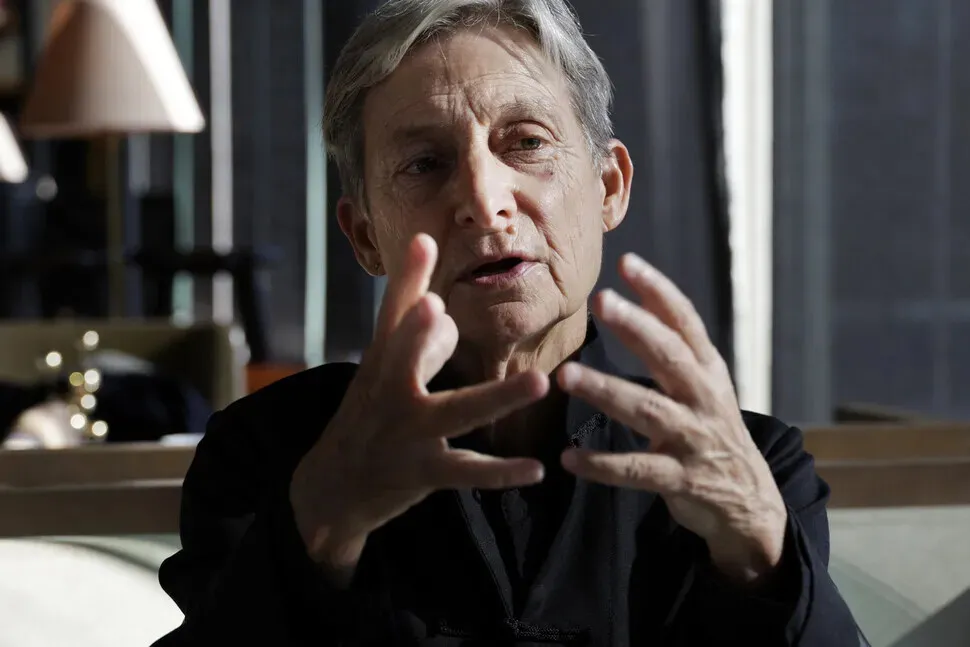
Gender theorist and political thinker Judith Butler speaks to the Hankyoreh21 in Seoul on Dec. 4, 2024. (Kim Myoung-jin/Hankyoreh)
Hankyoreh: Some argue that the time period “feminism” itself has traditionally been formed by white-centric, Western and colonialist norms, and thus demand a brand new political vocabulary that strikes solely past feminism. The place do you stand on this debate?
Butler: It doesn’t make sense to talk about an anti-trans feminism. Feminism is in opposition to discrimination on the premise of gender. Those that are anti-trans enact that discrimination. Any feminism well worth the identify shall be trans affirmative. And since each teams are focused by the precise, it’s extra essential to supply a coalition amongst us than to make offers with right-wing operators who’re focusing on a variety of precarious minorities.
Hankyoreh: Wouldn’t it be acceptable to grasp your work not primarily as gender concept, however as a political philosophy articulating a sustained critique of the differential distribution of livability and grievability?
Butler: Sure, it could be happy with me to explain my work that means. Even “Gender Bother” was involved with the query of a livable life. Mourning is just not itself a ample politics, but it surely contributes one thing essential to any helpful political motion: the acknowledgment of grief. My sense is that precarious lives are these that aren’t safeguarded from damage and dying and, in that sense, thought-about dispensable. And that implies that their standing as grievable beings is just not acknowledged: the lack of their lives wouldn’t rely as a loss. The world we wish to reside in ought to be one through which each life is grievable, and human lives could be linked with animal lives and dwelling processes. That is the place independency of life enters the image.
Hankyoreh: Debates over migration, abortion and gender are sometimes animated by phantasms, and on the core of the anti-gender motion lies the wrestle over who has the precise to marry, to type a household, and to be acknowledged as such by the state. If that’s the case, do you suppose that increasing state recognition of various types of family-making may alleviate a few of these conflicts?
Butler: In fact, increasing state recognition for a spread of household formations could be a superb factor, however such a transfer would additionally probably create a reactionary response. For individuals who imagine the household takes just one type, they need to maybe take into account the matter anthropologically. For what constitutes a household which is, in spite of everything, a particular group of kinship, varies throughout tradition and historical past. So many households are actually blended after divorce, separation, or dying of a mother or father, and these new formations are as equal in worth and dignity as another type. Kids must be well-loved and to grasp their world, to develop up with open hearts and a option to perceive the world through which they reside to allow them to make judgments about how they need the world to be, and to have interaction in no matter actions they deem essential for constructing that world. Which means respecting the autonomy of the kid, but in addition supplying a supportive infrastructure. When pathologization or shaming of a household formation takes place, the kid in that household has to wrestle in opposition to that effort to demean and devalue their very own household. No baby ought to have to do this! Though authorized recognition of various household formations is sweet, it’s not sufficient. It will be equally essential to vary spiritual, medical and academic establishments to acknowledge the varied ways in which youngsters are introduced into the world and raised in loving environments.
Hankyoreh: In South Korea’s historic context, anti-communism served as a strong instrument of political exclusion: these labeled “bbalgaengi” (“reds”) have been topic to hatred, surveillance and marginalization. At present, we see the same logic being deployed by means of the label of “gender.” If communism functioned through the Chilly Struggle as a damaging and totalizing political illusion, it appears that evidently “gender” now occupies a comparable function inside modern reactionary actions globally. In “Who’s Afraid of Gender?” you write that “fascism names the passions, however authoritarianism the rising, if not completed, political actuality” (p. 262). On this gentle, may we are saying that the present state of affairs in South Korea and related dynamics elsewhere as indicative of a type of rising or resurgent fascism?
Butler: You already know extra in regards to the modern Korean political state of affairs than I probably may. However I’m seeing completely different types of Christian nationalism that rely upon a basically slender, heteronormative thought of the household, and strict management of reproductive freedoms. Gender must be introduced into line with the heteronormative perfect, and each need to serve the copy of the nation-state in ways in which “defend” that nation in opposition to intrusion or contamination. Once we hear the language of “rooting out” communism or gender ideology, then we all know that nationalism has taken the type of purification. And nationwide purity is a slogan for fascist passions that externalize the enemy as a everlasting and deadly type of menace. Certainly, underneath such circumstances, the state can impose repressive measures within the identify of each spiritual norms and nationwide self-defense. We see this in Hungary, Russia and elsewhere.
Hankyoreh: If radical democracy is at all times unfinished and by no means assured, how can we maintain collective wrestle that doesn’t instantly yield recognition or return? How can we preserve combating when the work seems to go unanswered?
Butler: Throughout instances of political defeat, it’s most essential to show towards each other and construct communities of care and networks of mutual assist. These grow to be the social foundation for renewed social actions. One continues to construct one’s neighborhood, make alliances, learn, assemble and strategize throughout such instances. As a result of one by no means is aware of when the fissure will seem within the operation of dominant energy. These fissures are alternatives for brand new political emergences and for the shift in hegemonic powers. It will be fascinating to know whether or not progressive teams of spiritual communities are struggling in opposition to reactionary ones, and the way the shift in nationwide tradition and gender norms could also be occurring at ranges that aren’t essentially mirrored on the degree of parliamentary politics. Each anti-democratic regime is probably threatened by the individuals, which is why repression is critical for them. However their repressive actions are all “confessions” of concern, since no authorities can signify the individuals with out the help of the individuals.
Hankyoreh: If democracy rests on uncertainty, hope, too, should come up from that very same floor. What should we maintain onto, or apply collectively, with a purpose to preserve from shedding that hope within the midst of precariousness?
Butler: Mutual assist and types of native solidarity need to be matched by types of alliance each throughout the nation and transnationally. These could be strengthened throughout this time by means of open seminars, cultural occasions, well being care help, transportation and meals help, constructing a community of reciprocal care that articulates the rules by which a transformative political motion can emerge.
Hankyoreh: To these readers in Korea who look towards your subsequent work not just for concepts however for companionship within the lengthy work of dwelling — may you provide a phrase, a blessing of types, to accompany them as they go on?
Butler: I’d counsel to search out energy with each other, to withstand the heroism and despair of individualism, and to construct collectives regionally, to savor mental life, the world of the humanities, and multilingualism. Think about collectively, dream collectively, and develop collective braveness as a lifestyle.
By Lee You-jin, senior employees author
Please direct questions or feedback to [english@hani.co.kr]
