


From left, Cho Jin-woong, Park Na-rae and Cho Se-ho / Courtesy of Contents Wavve, Hankook Ilbo file, MBC
A string of private scandals involving high-profile Korean entertainers is as soon as once more leaving broadcasters and manufacturing firms to soak up heavy monetary and scheduling losses and reigniting considerations about long-standing vulnerabilities within the nation’s leisure ecosystem.
Latest controversies tied to actor Cho Jin-woong, TV persona Park Na-rae and comic Cho Se-ho have compelled networks to cancel applications, halt filming and even scrap accomplished initiatives — with few efficient instruments out there to stop or recuperate damages.
Accomplished initiatives face collapse as re-editing turns into unattainable
The fallout escalated on Saturday when Cho Jin-woong introduced his retirement from the leisure business after reviews surfaced about his juvenile felony document. Broadcasters instantly moved to erase his appearances, changing his narration in a documentary and making earlier applications that includes him non-public on YouTube. Park, who’s going through allegations associated to unlawful medical procedures, suspended all actions, ensuing within the cancellation of MBC’s upcoming selection present “Nado Shinna,” which was set to air subsequent yr.
Probably the most extreme blow, nonetheless, could also be tvN’s “Sign 2,” deliberate as a flagship drama celebrating the community’s twentieth anniversary subsequent yr. Cho had reunited with author Kim Eun-hee and actors Kim Hye-soo and Lee Je-hoon — all members of the unique solid — and filming had been accomplished in full. However the controversy has now put the drama’s broadcast schedule at severe threat.
Modifying out problematic actors or recasting roles is feasible in some instances. When actor Yoo Ah-in grew to become embroiled in a drug scandal, producers eliminated him from Netflix’s “Hellbound 2,” and one other drama, “Goodbye Earth,” minimized his display screen time by means of re-editing. However “Sign 2” presents a special dilemma: The collection reportedly value greater than 10 billion gained ($7.5 million) to provide, and Cho performs a central detective whose scenes are integral to the storyline. With postproduction practically completed, reshoots are thought of unfeasible, and tvN stated it’s “reviewing a number of choices.”
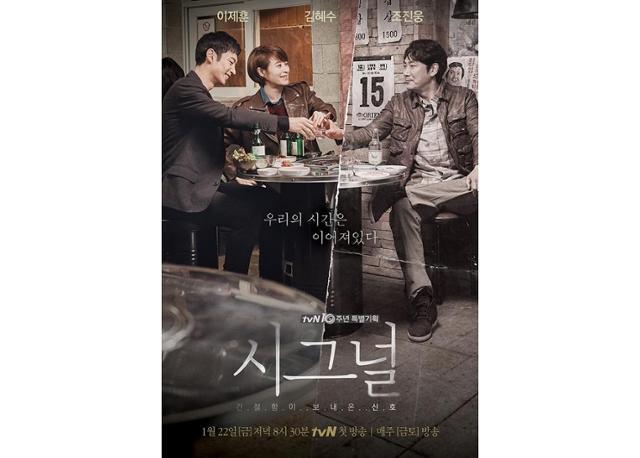
A poster for “Sign” / Courtesy of tvN
Penalty clauses exist, however lawsuits are uncommon
For now, inserting compensation clauses into casting contracts stays the business’s solely formal safeguard. Broadcasters and manufacturing firms can’t examine an actor’s non-public life or previous conduct as totally as legislation enforcement businesses, making prescreening practically unattainable. To handle this hole, the Ministry of Tradition, Sports activities and Tourism revised its commonplace broadcasting contract for entertainers in July for the primary time in 12 years.
Nonetheless, these clauses have restricted real-world affect.
“We typically embody provisions corresponding to ‘In case of public scandal, the actor should return one to a few occasions the looks payment,’ however instances that really result in lawsuits are extraordinarily uncommon,” a movie firm CEO with twenty years of expertise stated. Recovering full damages is sort of unattainable, the CEO added, and lots of firms forgo authorized motion attributable to potential conflicts with businesses, excessive authorized prices and the anomaly of what constitutes “public scandal.” Disney+, for example, indefinitely postponed the discharge of actor Kim Soo-hyun’s collection “Knockoff” final yr amid allegations that he dated a minor, however didn’t pursue penalty charges.
Negotiating penalty clauses with prime stars can be practically unattainable. “Throughout contract negotiations, it is vitally troublesome for manufacturing firms to make calls for that actors discover uncomfortable. Except specialised insurance coverage merchandise turn out to be out there, producers haven’t any selection however to shoulder the danger,” one other movie producer stated.
A broadcasting official echoed this sentiment. “Korean drama manufacturing closely is determined by star writers, administrators, and actors. They maintain overwhelming energy within the system.”
Consultants argue that broader institutional options are wanted to guard the business when main stars turn out to be embroiled in controversy.
“In the USA, there are insurance coverage mechanisms and arbitration firms devoted to addressing losses when large-scale content material initiatives crumble,” cultural critic Kim Sung-soo stated. “If insurance coverage is troublesome to introduce in Korea, the federal government and personal sector ought to take into account making a governance framework tasked with harm evaluation, compensation, and IP administration.”
This text from the Hankook Ilbo, the sister publication of The Korea Instances, is translated by a generative AI system and edited by The Korea Instances.
