

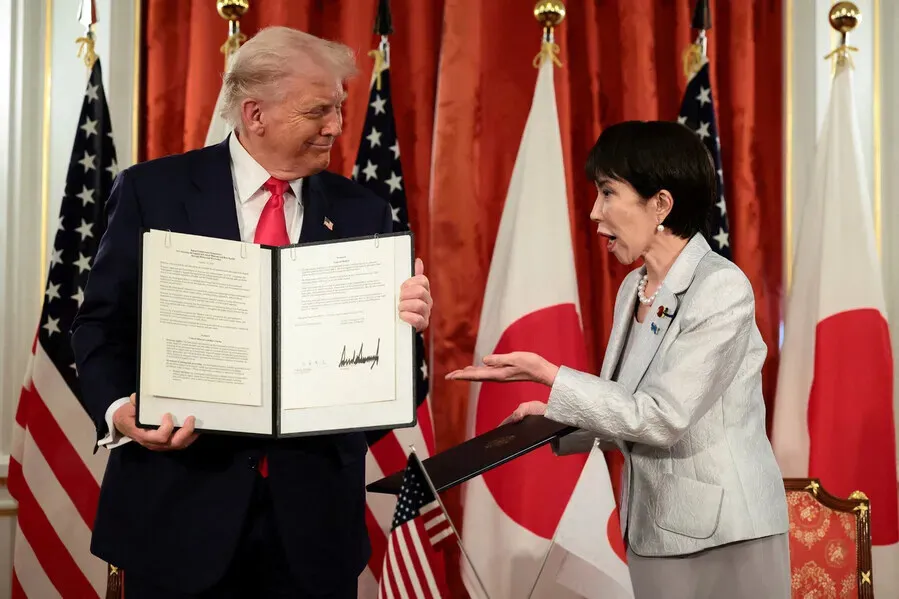
US President Donald Trump holds up a replica of the settlement he and Japanese Prime Minister Sanae Takaichi (proper) signed on commerce throughout their assembly in Tokyo, Japan, on Oct. 28, 2025. (Reuters/Yonhap)
South Korea and the US might have reached an settlement of their tariff negotiations in October, however what’s going to really come of it stays unsure.
Some observers declare there isn’t a must view the matter with undue pessimism, citing how South Korea was capable of overcome varied poisonous clauses that disfavored it throughout negotiations towards a bilateral free commerce settlement with the US 20 years in the past.
Whereas it’s true that South Korean corporations turned the FTA into a chance to improve worldwide competitiveness, it’s not clear that the identical expertise could be utilized to the tariff settlement. A central component on the time was the decreasing of tariff charges for various objects on either side. In distinction, the newest negotiations concerned solely concessions from the South Korean aspect.
Korea’s common tariff charge for US imports remained at 0.79%, whereas the tariff charge alone for Korean imports to the US rose to fifteen%. An particularly problematic situation is the requirement for Korea to pay out US$200 billion of its whole US$350 billion in US funding as authorities funds.
Whereas Korea is entitled to US$150 billion in funding returns within the space of shipbuilding, revenue from the federal government funding is to be divided 50-50 with the US till the principal is recouped, at which level it’s only entitled to a ten% share. The important thing query right here is whether or not it is going to even be doable to satisfy the Korean goal of recouping the funding principal inside 20 years.
Estimated web loss for Japan: $127.3 billion to $191.3 billion
Not too long ago, two researchers affiliated with the Federal Reserve Financial institution of St. Louis revealed a report analyzing the US$550 billion funding memorandum of understanding between the US and Japan. The researchers YiLi Chien and Masataka Mori identified that it’s unclear what would occur if Japan failed to totally get better the principal and curiosity. This means that the unrecovered the rest would finally need to be written off as losses.
Assuming a ten% annual return for 30 years adopted by no additional returns, Chien and Masataka estimated the utmost and minimal recoverable sums for Japan: US$422.7 billion and US$358.7 billion. Subtracting the recoverable quantity from the whole $550 billion funding yields Japan’s web loss, from US$127.3 billion at minimal to US$191.3 billion at most.
The researchers added that these calculations had been conservative estimates, which used the 30-year US Treasury yield, which was about 5%, because the low cost charge when figuring out current worth. If investments are made in higher-risk tasks, a better low cost charge would apply, doubtlessly heightening the online loss.
For the US, alternatively, the MOU is structured so that it’s going to acquire the proceeds with out making any funding in any respect — the US has ensured revenue in any situation. For the US, earnings vary from a minimal of US$423 billion to a most of US$487 billion.
For Japan to make a web revenue, it must at the least double its authentic funding (based mostly on present worth) in a extremely worthwhile undertaking. It is because half of the earnings return to the US.
Nonetheless, the 2 researchers mentioned that it’s “unlikely that government-directed investments may constantly generate returns (in present-value phrases) which are twice the preliminary funding quantity.”
“The reason being simple: If such worthwhile alternatives actually existed, non-public buyers would possible have already exploited them,” they wrote.
“Underneath the present construction, the earnings earned by the US authorities could be interpreted as a type of international funding tax imposed on the undertaking. The implied tax charge exceeds 50%, since US earnings are constantly at the least as giant as these accruing to Japan,” they mentioned.
The transaction quantities to the US exploiting the capital of its ally.
That is an estimate based mostly on sure presuppositions, so there’s no must take it at face worth, however it’s an evaluation performed by researchers at a distinguished US establishment, so the figures shouldn’t be dismissed both. Other than the clause that limits Korea’s annual investments to US$20 billion, the US-South Korea funding MOU is structurally just like the deal signed between the US and Japan.
When Chien and Mori’s strategies are utilized to Korea’s funding pledge, the dimensions of losses can be smaller, contemplating that we pay US$200 billion over a 10-year interval. Nonetheless, this might find yourself being wherever from within the billions to the tens of billions of {dollars}.
US offers with South Korea and Japan are a variation of the “Mar-a-Lago Accord”
Washington’s offers with Seoul and Tokyo are paying homage to the “Mar-a-Lago Accord” proposed by Stephen Miran, the chair of the Council of Financial Advisers to Trump. After serving as chair, Miran was specifically appointed to grow to be a member of the Federal Reserve Board of Governors in September.
In November of final 12 months, Miran revealed a paper titled “A Person’s Information to Restructuring the International Buying and selling System,” through which he made groundbreaking arguments that caught the world’s consideration. Miran acknowledged that if the US and different nations attempt to preserve holdings of US {dollars} as a reserve forex, it is going to inevitably result in a stronger greenback. Whereas this is able to consequence within the greenback having fun with a particular standing of being the worldwide reserve forex, it could not directly result in the weakening of export competitiveness, ensuing within the present “Rust Belt” phenomenon of the declining manufacturing base.
As an answer, Miran proposes elevating tariffs whereas concurrently driving down the greenback. Concretely, he proposed the next two options. The primary is to cost a “person payment” on international nations holding US Treasuries as a reserve asset. The opposite is to transform short-term US Treasury payments into 100-year Treasury bonds. If a rustic refuses, Miran argues that the US ought to use the stick by elevating tariffs and withdrawing the safety of its protection umbrella.
As if borrowing instantly from the identify “Plaza Accord,” the 1985 settlement the US brokered with West Germany, the UK, Japan and France, Miran named his proposal the “Mar-a-Lago Accord,” after Trump’s Florida resort. The big-scale funding settlement reached between the US and Japan is structurally totally different from Miran’s proposal, however the outcomes are considerably just like Miran’s imaginative and prescient.
The workplace of South Korean President Lee Jae Myung introduced that it could use foreign exchange earnings to fund the annual higher restrict of US$20 billion in investments within the US.
South Korea’s international forex holdings quantity to US$430 billion. Round 70% of those holdings are in dollar-based belongings. Via the ensuing curiosity and dividends, the Korean authorities makes round US$15 billion yearly. Underneath the brand new association, earnings that South Korea makes by holding {dollars} will now return to the US. This, basically, means we’re paying a “person payment” for holding {dollars}.
Even after recouping the principal, it should keep inside the US. Any ensuing earnings should be break up 90:10 within the US’ favor. That’s not a lot totally different than buying 100-year Treasury bonds and conserving many of the earnings inside the US.
The Plaza Accord of 40 years in the past was an oblique restructuring of world commerce by intervening within the international trade market. The US’ present strategies contain elevating tariffs and extorting giant quantities of capital from allies by inserting stress on them to make international direct investments.
As of late October 2025, South Korea, Japan, the EU, and rich Center Jap nations have pledged to take a position over US$5 trillion within the US. If these investments are realized to the required quantities, the US could have succeeded in securing the most important funding in historical past.
If international direct funding is utilized correctly, the beneficiary can create appreciable financial worth by means of technological innovation and employment. For the worldwide economic system to run easily, capital must be ample, and technologically superior nations must put money into growing nations. However within the Trump period it’s the other. Malaysia, whose GDP per capita is round US$12,000, pledged to take a position US$70 billion within the US throughout Trump’s go to to Malaysia in October. It’s not hyperbole to name any such extortion by a rustic whose GDP per capita is US$85,000 “financial imperialism.”
“Tacit deal” of an alliance in peril
Since World Warfare II, the US has led the development, preservation and growth of the liberal worldwide financial order. Nonetheless, Pax Americana was maintained for 80 years as a result of allies and pleasant nations proactively cooperated. The US offered entry to monetary markets and prolonged its protection umbrella; in return, allies acknowledged US hegemony and cooperated in its international coverage, safety and macroeconomic networks.
Michael Mastanduno, a professor at Dartmouth School, wrote an article titled “System Maker and Privilege Taker” through which he argues that the US and its cooperative companions engaged in a form of political transaction that assured the US’ particular standing whereas fulfilling every nation’s respective financial and safety calls for. He refers to this association as a “tacit deal.”
Through the Chilly Warfare, Japan and Western Europe had been the US’ most essential financial companions. After the Chilly Warfare, the US’ community of cooperative nations expanded to incorporate China and wider East Asia.
After the 2008 monetary disaster, Korea entered such ranks by changing into a member of the Group of 20. There have been a couple of situations the place the tacit deal was in peril of being damaged. Because the US suffers twin deficits — fiscal and commerce deficits — and a decline in hegemonic standing as a consequence of its weakened manufacturing base, it’s passing the austerity prices to its allies. The “Nixon shock” of the Nineteen Seventies that ended the US greenback’s gold customary and the 1985 Plaza Accord are examples of such situations.
The US has lengthy been the system maker and the privilege taker within the liberal worldwide financial order, however this time it’s totally different. Underneath Trump’s MAGA ideology, the foundations of free commerce rules are faltering, and the US is pushing companion nations to their limits by means of particular person bilateral commerce offers. Trump is looking for the US to “money out” its hegemony, and the US is changing into a system destroyer. At this charge, will the tacit offers of the previous proceed?
By Park Hyun, editorial author
Please direct questions or feedback to [english@hani.co.kr]
