

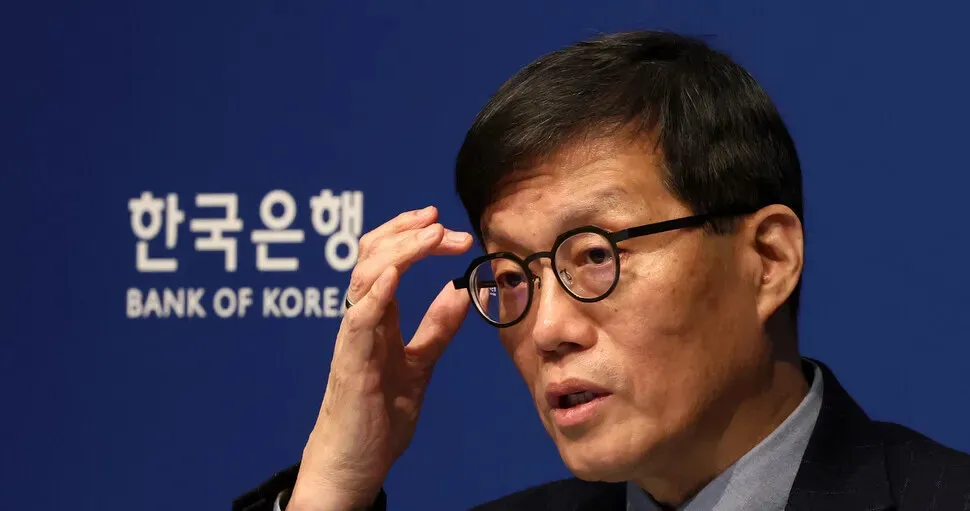
Financial institution of Korea Governor Rhee Chang-yong speaks to reporters at a briefing held on the central financial institution on Jan. 15, 2026. (pool picture)
The Financial institution of Korea’s sign Thursday that it is going to be ending its easing cycle could be learn as an try and curb market issues that additional rate of interest cuts might push the alternate fee larger.
Because the won-dollar alternate fee continues its relentless rise, with complete market interventions and supply-demand measures proving ineffective at bringing it down, the central financial institution is resorting to the comparatively toothless measure of macroeconomic financial coverage.
The BOK’s Financial Coverage Board froze the bottom fee, utterly omitting wording referring to rate of interest cuts from its assertion on the financial coverage choice on Thursday. The central financial institution had moved from an easing cycle to a extra impartial stance within the fourth quarter of 2025, however this assembly marked an extra hawkish shift towards a protracted fee freeze. Rate of interest cuts usually decrease the worth of the received, exerting upward stress on the alternate fee and inflation.
The board has considerably stepped up its vigilance on the volatility of the alternate fee. The final Financial Coverage Board assembly in November 2025 noticed one dissenting vote for a fee minimize, however the Thursday assembly noticed a unanimous choice to carry charges regular, with no dissenting opinions. The outlook for future charges has additionally shifted decisively to a hawkish stance.
Members of the board, six excluding the governor, overwhelmingly favored sustaining the present rate of interest, with 5 members voting for a ahead steering scheme with an outlook of no fee cuts throughout the subsequent three months. That marked a big shift from the November assembly, when opinions had been evenly break up three-to-three between cuts and sustaining charges.
The member who argued for protecting the door open to a possible minimize added the caveat that “the choice needs to be based mostly on monetary stability variables,” reflecting the judgment of the vast majority of the board members that monetary stability dangers, equivalent to alternate charges and housing costs, have elevated considerably.
The BOK analyzed that exterior components such because the yen’s weak spot and geopolitical dangers accounted for three-quarters of the alternate fee’s backsliding, whereas the remaining quarter was attributable to home components, equivalent to provide and demand. The won-dollar alternate fee fell from the 1,480 received vary to the 1,420 vary following the international alternate authorities’ robust interventions and supply-demand measures on Dec. 24, however has since risen to the 1,470 received vary for the reason that begin of the brand new yr.
“The Nationwide Pension Service has begun foreign money hedging operations for the reason that authorities’ stabilization measures final month, and abroad funding has decreased. Corporations have additionally introduced international foreign money again from abroad,” Gov. Rhee Chang-yong of the BOK informed reporters at a press convention.
“However, particular person buyers repeatedly purchased massive quantities of {dollars} when the alternate fee fell to a sure degree, and the size of abroad inventory investments additionally grew to the extent seen in October and November of 2025,” he added.
Numbers from the Korea Securities Depository point out that web purchases of US shares by particular person buyers reached US$2.24 billion over the primary 9 buying and selling days of 2026 (by Jan. 14), already surpassing the overall for December 2025 (US$1.87 billion).
“The issue lies in the truth that individuals are anticipating the alternate fee to rise, subsequently solely lending {dollars} within the spot market as an alternative of promoting,” Rhee famous.
Greenback-holding sentiment is inflicting {dollars} to be considerable within the lending market whereas being scarce within the spot market.
Nevertheless, Rhee dismissed the opinion that the bottom fee must be raised to decrease the alternate fee.
“Six months in the past, folks had been accusing us of lacking alternatives by not chopping charges; now, they’re saying that we’re on this scenario as a result of we didn’t increase charges when the alternate fee was rising. The BOK’s rate of interest coverage just isn’t swayed by the alternate fee, however by inflation,” he mentioned. As such, the governor has emphasised the precept that rates of interest can’t be used as a software to reply to the depreciation of foreign money.
Opinions are divided on whether or not this marks the top of the rate-cutting cycle. Many predict that charges will stay unchanged for the remainder of the yr, however some counsel there’s a risk of fee cuts resuming within the second half of 2026.
“The route that the bottom fee will take after a protracted freeze might be decided by fundamentals. If development within the second half of the yr is less-than-satisfactory, fee cuts will resume,” commented Park Jun-woo, an analyst with Hana Securities.
As expectations for fee cuts light following the Financial Coverage Board’s choice, yields on authorities bonds rose sharply within the Seoul bond market. The yield on three-year authorities bonds rose 9.4 foundation factors to three.090%, whereas the yield on 10-year authorities bonds elevated 7.5 foundation factors to three.493%.
By Kim Hoe-seung, senior employees author
Please direct questions or feedback to [english@hani.co.kr]
